

Cyberpunk 2077 gives you thousands of lines of voiced English, readable subtitles, dialogue choices, messages, and quest text. The problem is speed: one unfamiliar phrase can make you miss the point of a conversation, while opening a browser or dictionary pulls you out of the game.
Termy removes that interruption. Press Alt + X on a subtitle, dialogue choice, shard, or objective. Termy pauses the game, reads the visible text, highlights difficult words and phrases, and explains them in context.
This guide shows you how to improve your English by playing Cyberpunk 2077, understand Night City slang, and keep the vocabulary that is useful outside the game. Try Termy free while you play.
Content note: Cyberpunk 2077 is rated Mature 17+ for blood and gore, intense violence, nudity, strong language, strong sexual content, and drug and alcohol use.
How difficult is Cyberpunk 2077 in English?
I would recommend it most confidently to a strong B2 or C1 learner. At that level, you can usually follow the situation while still having useful gaps to investigate. You will meet fast informal speech, omitted words, sarcasm, technical abbreviations, police and military language, corporate jargon, and slang invented for the setting.
A B1 learner can still play in English, especially on a second playthrough, but should expect to miss detail. The main challenge is not one enormous word. It is density: a familiar verb, a fictional noun, an implied threat, and an interrupted sentence can all arrive in five seconds.
Before changing the language, ask yourself a practical question: can you usually understand why two characters are arguing, even if several words are unknown? If yes, the game can stretch your English. If you understand individual words but lose the purpose of the whole exchange, use English subtitles with audio you understand, or replay a familiar section first.
Make the subtitles work harder
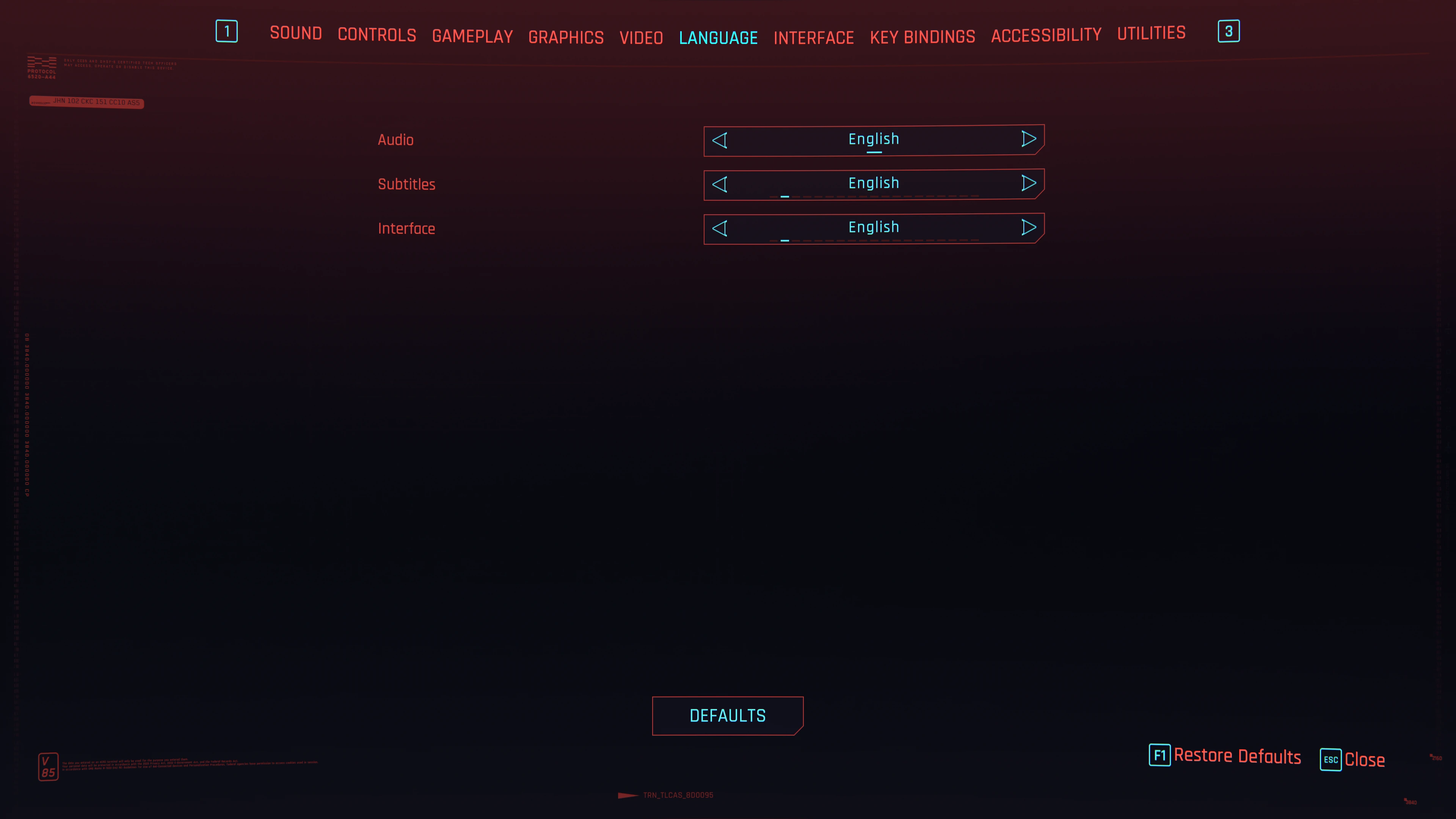
Cyberpunk gives learners better controls than many dialogue-heavy games. Its accessibility settings let you enable cinematic, radio, and overhead subtitles separately. You can also change subtitle size and background opacity. CD Projekt Red's accessibility guide lists six cinematic text sizes and five overhead text sizes.
For an English-learning playthrough, start here:
- Use English audio and English text. Matching sound and spelling helps you connect what you hear with what you can later recognize.
- Increase text size before it feels necessary. You should be reading the sentence, not fighting the interface.
- Raise subtitle background opacity. Night City's lights and movement make contrast more important than style.
- Enable overhead subtitles. Background conversations add repeated slang and ordinary speech, although you do not need to study every one.
- Try radio subtitles selectively. They are useful when you are parked or walking, but extra text during a chase can become noise.
Language availability differs by platform, store region, and edition. Check the official support page for your copy before buying a second version just for a particular dub. On Nintendo Switch 2, for example, English is included globally while several other voice packs require a separate download.
Cyberpunk 2077 vocabulary has two layers
Night City mixes invented or repurposed slang with English you can use elsewhere. Treating both layers as one vocabulary list is a mistake. You need the first layer to understand the game; the second is where most long-term learning value lives.
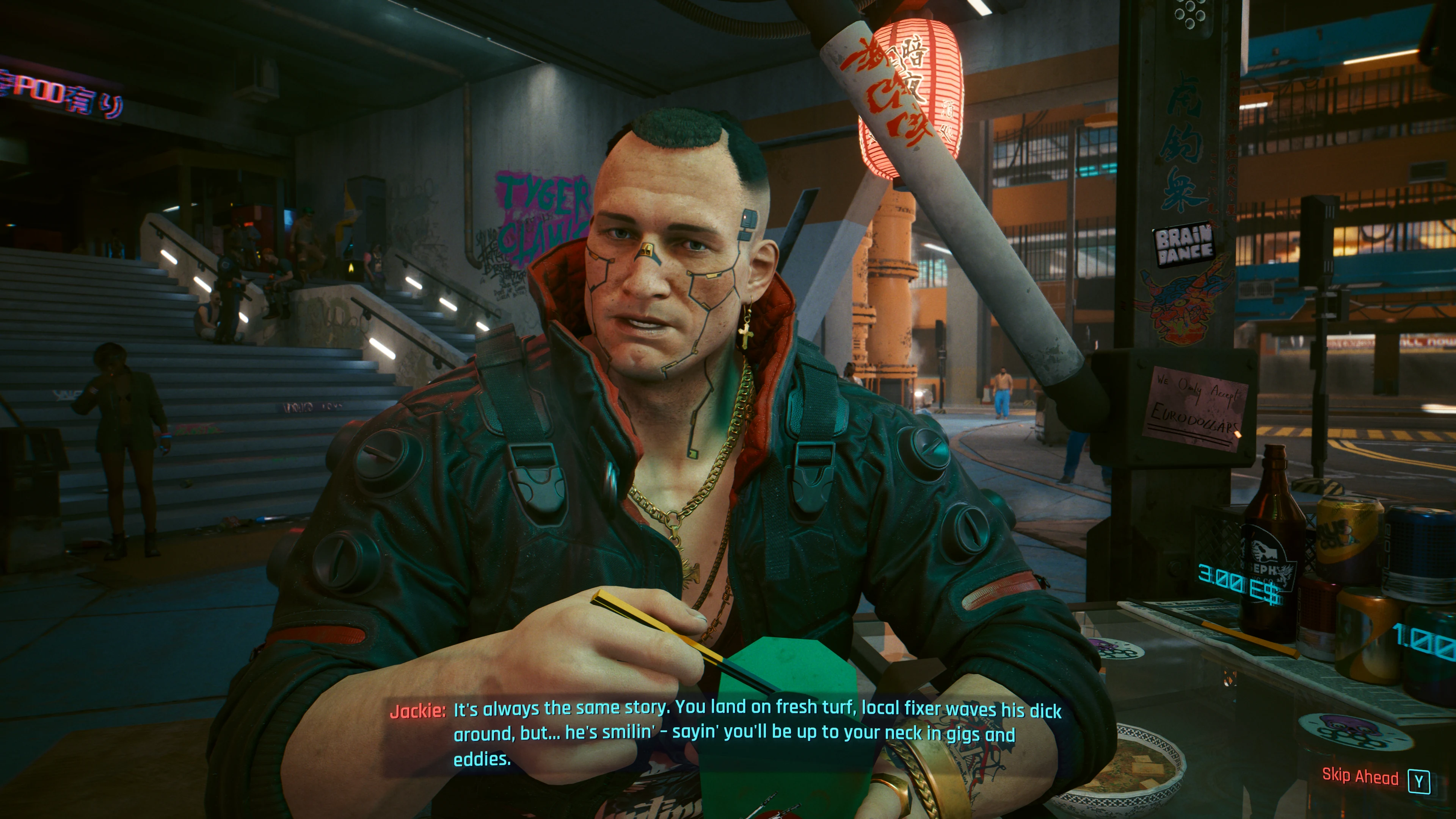
| Term | Meaning in Night City | Keep or recognize? |
|---|---|---|
| choom | A friend, companion, or casual form of address. | Recognize. It marks friendliness or shared identity inside this world. |
| eddies | Money—specifically Eurodollars. | Recognize. Outside Cyberpunk, people will normally say money, cash, or a currency name. |
| corpo | A corporation employee, or someone shaped by corporate power. | Recognize, then keep the real adjective corporate. |
| gig | A paid job offered to a mercenary. | Keep. In real informal English, a gig can be a performance or a temporary piece of work. |
| fixer | A connected intermediary who arranges work and solves problems. | Keep with care. The real word often suggests discreet influence or questionable methods. |
| ripperdoc | A specialist who installs and maintains cybernetic body modifications. | Recognize. It combines the familiar idea of a doctor with a fictional profession. |
| braindance | A recorded experience that reproduces another person's sensations. | Recognize. Learn the surrounding real words: recording, sensory, and playback. |
| flatline | To die or kill; the image comes from a medical monitor showing no heartbeat. | Keep as informal English, but understand that it is blunt and often dramatic. |
Context usually teaches these terms faster than a glossary. If a fixer offers three gigs and every gig produces an objective and a payment, the word's function becomes hard to miss. The official site itself uses the same language when it says that fixers have gigs and apartments cost eddies.
The most valuable words are hiding behind the slang
Once the local dialect stops feeling strange, listen for the words characters use to hide power. Night City is full of people who make threats sound administrative:
Leverage is an advantage you can use to influence a person or situation. Information, money, and access can all give someone leverage.
Original example: “The messages gave her enough leverage to renegotiate the deal.”
A liability is a legal or financial responsibility. Informally, it can mean a person or thing that creates risk for a group.
Original example: “A witness who knows the plan could become a liability.”
As a verb, compromise can mean to weaken, expose, or put something at risk. A compromised system may no longer be secure. This differs from the noun meaning an agreement in which both sides accept less.
Useful contrast: reach a compromise versus compromise security.
Collateral is property promised as security for a loan. In the phrase collateral damage, it means unintended harm caused while pursuing another target.
Original example: “The operation succeeded, but the collateral damage was impossible to defend.”
Discretion can mean careful secrecy or the freedom to decide what to do. “Use your discretion” means “judge the situation yourself”; “absolute discretion” may be a polite demand for silence.
These words travel far beyond the game. You will meet them in business news, thrillers, workplace conversations, and politics. Save them before you save the name of every weapon attachment.
Read the speaker's goal before the sentence
Cyberpunk dialogue often removes the grammar textbooks teach first. Characters drop subjects, auxiliaries, and polite openings: “Need a ride?” instead of “Do you need a ride?”; “Got a problem” instead of “We have a problem.” This is normal in fast informal speech when the missing part is obvious.
Do not rebuild every fragment word by word while the scene continues. First decide what the speaker is doing:
- Offering: What do they want you to accept?
- Pressuring: What consequence are they implying?
- Withholding: Which fact are they carefully not saying?
- Bargaining: What would make them change the deal?
- Performing status: Are they trying to sound professional, fearless, loyal, or dangerous?
Once you know the social action, unknown vocabulary has boundaries. A word inside a payment negotiation probably concerns value, risk, or trust. A word beside an objective marker probably concerns place, access, or action. The situation becomes part of the definition.
Shards are your quiet classroom
Spoken scenes are memorable, but shards, messages, job descriptions, and database entries give you time. They also reveal a different register: complete sentences, technical explanations, public advertising, private messages, and official-sounding reports.
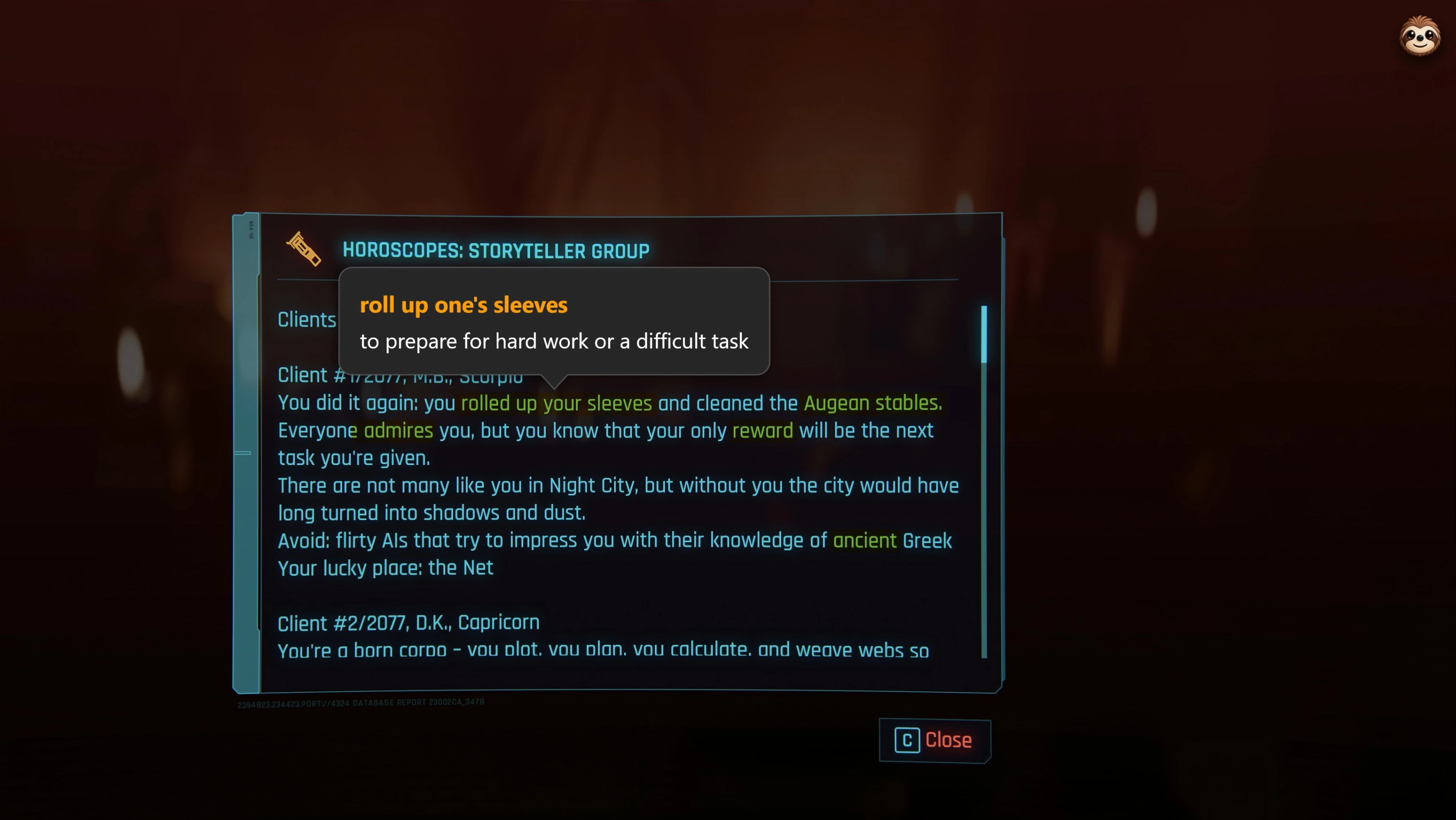
Do not read every shard as soon as you collect it. That can turn exploration into paperwork. Choose one after a quest and use a three-pass scan:
- Read for purpose. Is this warning, persuading, documenting, or telling a story?
- Mark the repeated language. Names and model numbers may not matter; a repeated verb or relationship word probably does.
- Check one blocking phrase. Then reread the paragraph without the definition open.
The scale of the game's writing is not imaginary. When CD Projekt Red added Ukrainian text support, its localization team said that adapting the base game and expansion involved well over a million words of dialogue, interface text, and other writing. You are not supposed to turn all of that into flashcards.
Use listen–read–infer–check
For one focused session, choose a story job or two nearby gigs and try this loop:
- Listen. Let the line finish before reaching for a definition.
- Read. Use the subtitle to catch spelling, names, and sentence structure.
- Infer. Decide what the speaker wants and guess the unknown phrase from the consequence.
- Check. Look up only the phrase that changes your understanding of the choice.
- Paraphrase. Before choosing, say the option in simpler English: “I am refusing,” “I want more money,” or “I do not trust this plan.”
Stop after three to five useful checks. At the end, keep one Night City term for comprehension and two transferable English items for actual study. A good result might be choom for the game, then leverage and compromised for life outside it.
Let Termy pause the game for you
You do not need to reach a safe pause point first. When a subtitle, conversation, shard, objective, or interface term blocks you, press Alt + X. Termy pauses the game automatically, reads the visible text, highlights the most difficult words and phrases for your level, and explains them in context. Hover over a highlight to see its explanation; if the word you need is not highlighted, click it directly.
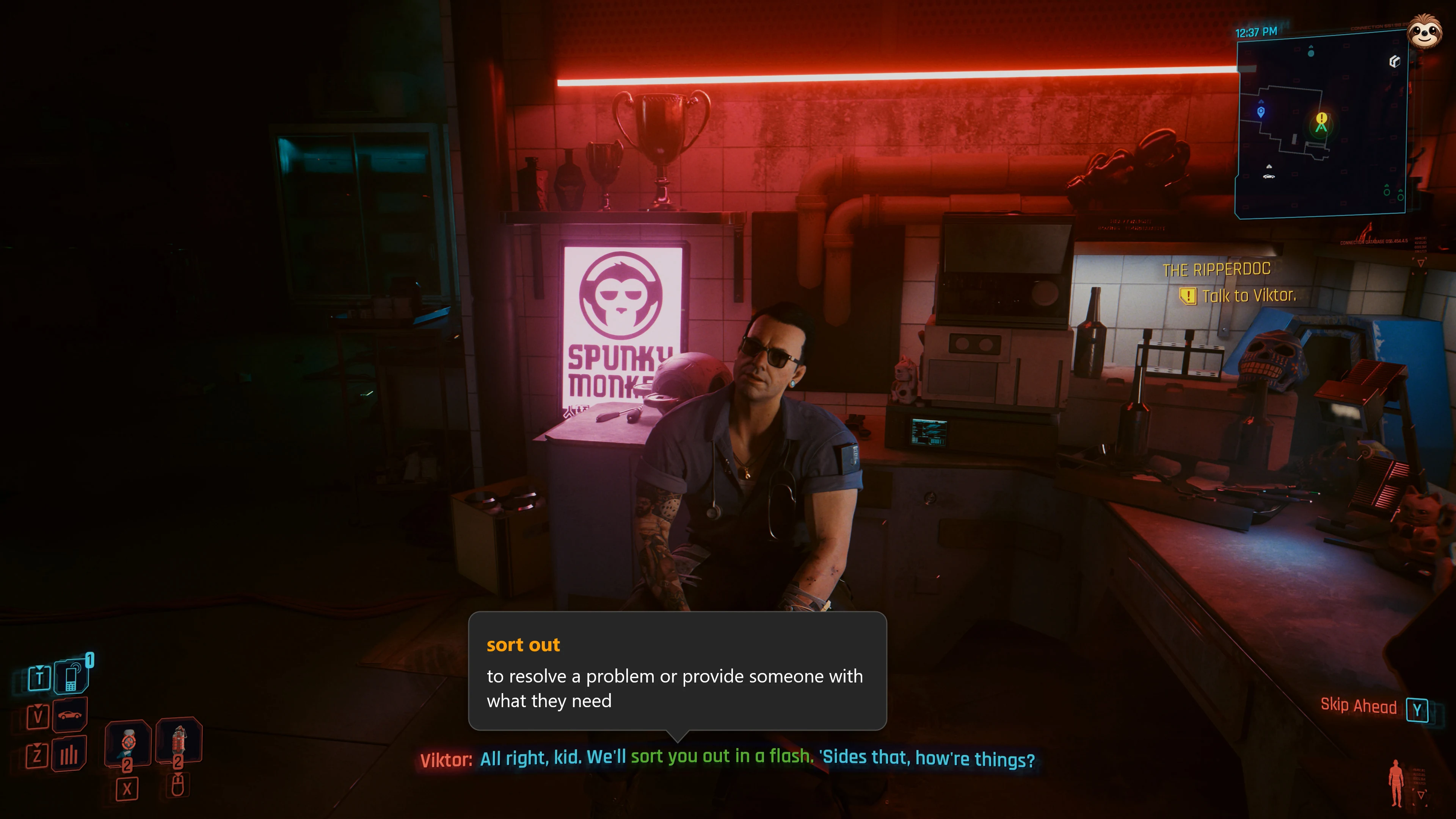
If the explanation is still too difficult, use the reverse icon in the bubble to switch to a translation. Then close the overlay and reread the original line once. That last reread matters: it reconnects the meaning to the game instead of leaving it inside a dictionary window.
The automatic pause is the important part: you can capture a difficult line when it appears instead of waiting for a menu or losing it. The explanation stays connected to the original scene, so you understand the vocabulary and the situation together.
For another game where vocabulary changes the meaning of a choice, read Learn English with Fallout: New Vegas.
Do not become a tourist with a phrasebook
Memorizing twenty slang terms before starting will not make Night City sound natural. You learn its dialect the way you learn a real city's habits: repeated encounters, different speakers, consequences, and occasional misunderstandings.
Turn on readable subtitles. Let a conversation finish. Identify the deal beneath the words. Check what blocks the decision, then move. Soon choom, gig, and eddies will stop looking like vocabulary and start feeling like coordinates—and you can spend your attention on the English worth carrying home.
Cyberpunk 2077 and CD PROJEKT RED are trademarks of their respective owners. This independent language-learning guide is not affiliated with or endorsed by CD PROJEKT RED.
Decode the deal, make the choice, and keep moving through Night City.
Try Termy free with Cyberpunk 2077Back to all articles