

Fallout: New Vegas opens with a bullet to the head, then slows down and asks you to listen. You wake as a Courier in the Mojave Desert, where settlements and armed groups are fighting over the future. Before long, people want information, help, loyalty, money, or revenge. The answer you choose can reveal a new route through a quest, improve your standing with a faction, or turn a conversation into a fight.
Dialogue is one of the main ways you play. To learn English with Fallout: New Vegas, you need enough language to understand what each person wants—then you have to decide what your Courier would actually say.
Fifteen years after release, Bethesda announced a 15th Anniversary Bundle for PC. The original game also received more than 1,200 Steam reviews in the 30 days before this guide's fact check. Its age is part of the attraction: response lists give you time to read, while its writing still produces arguments about politics, motives, and consequences.
Spoiler-light content note: this guide avoids story outcomes. Fallout: New Vegas is rated Mature 17+ for blood and gore, intense violence, sexual content, strong language, and drug use.
Before you leave Goodsprings
I would recommend the game most confidently to a B1 or B2 English learner. A B1 player can follow the main story with help, although political arguments, old-fashioned Western speech, and casino language will slow some conversations down. At B2, the more interesting work is reading tone: is this person warning you, threatening you, bargaining with you, or trying to make an ugly deal sound reasonable?
A strong A2 learner can still begin in English. Keep the first sessions short, turn on subtitles, and accept that some background details will pass by. Your first goal is not to understand the whole Mojave. It is to understand the next decision.
If you have already played New Vegas in your native language, the switch is easier. You know the world, game systems, and basic goals, so you can give more attention to English. Replay a familiar area or continue with a short English session; you do not need to restart the whole game.
You also need a quick way to check a phrase that blocks the choice. Any dictionary can do this. I created Termy because leaving a game, typing out the phrase, and then rebuilding the scene in your head can break the conversation. Termy is optional. Its shortcut simply shortens that one check.
Why New Vegas gives words consequences
Many games let you ignore dialogue and follow a marker. New Vegas does give you quest markers, but the conversation often tells you why the marker matters. A character may offer one version of events while another person gives you a reason to doubt it. If you understand only the destination, you can finish the task and still miss the choice.
The official manual tells players to choose the response that fits the situation and expect the other character to react. Some options appear only because of a skill, perk, or faction reputation. A line marked [Sneak], [Barter], or [NCR] therefore carries two kinds of English at once: the sentence itself and a label explaining why your Courier can say it.
This creates useful repetition without repeating an identical exercise. Words such as reputation, faction, hostile, and objective return in menus and conversations. The situation changes, but the core meaning stays stable. You meet the language as a player, not as a list.
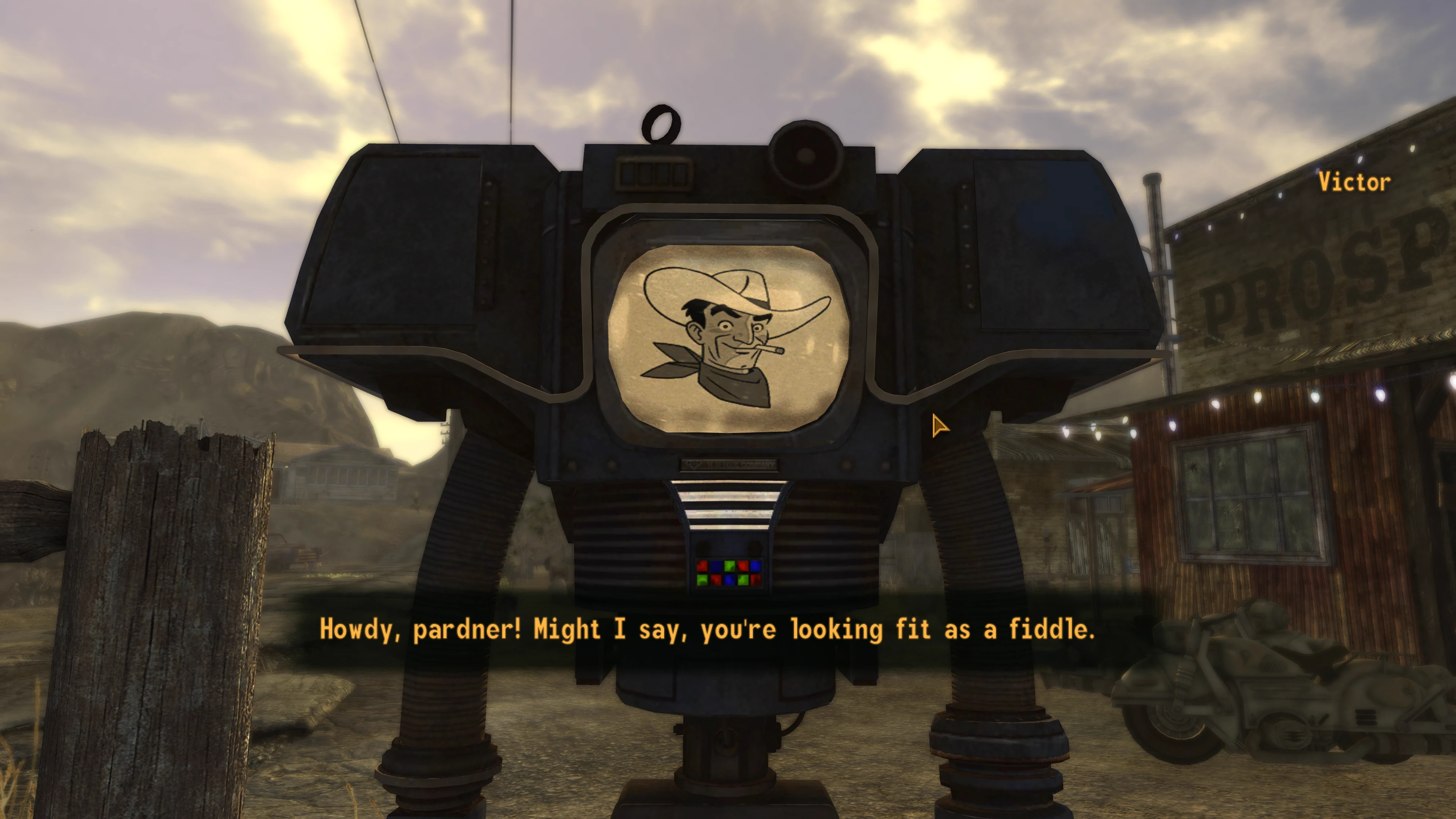
Listen to who is speaking and the vocabulary shifts. Soldiers use ranks, orders, and formal group names. Traders talk about value and supplies. Casino workers use the language of bets and payouts. People in small settlements speak more casually, while powerful characters may hide a threat inside polite language. Real English changes with purpose and social position too.
Use read–think–check–return
This is the method I used when learning English through games. The basic loop is read–think–check–return: understand the scene first, check only what blocks you, and keep playing.
- Read. Let the character finish, listen once, and read the subtitle or response list. Do not stop at the first unknown word.
- Think. Who has power? What does each person want? Is the speaker asking, warning, refusing, bargaining, or persuading? Compare what your possible responses would do.
- Check. Look up only the word or phrase that changes the choice, blocks an instruction, or keeps returning.
- Return. Close the dictionary, choose, and continue. The character's reaction becomes feedback on both your English and your role-playing decision.
Suppose one response sounds friendly except for the verb yield. In this setting, yield can mean to stop resisting or surrender. That meaning changes the choice, so it is worth checking. If the unknown word is the name of a one-time weapon beside a response you already understand, leave it alone.
The response list is your safest reading point because the game is waiting for your selection. During combat, use V.A.T.S. or the pause menu before checking anything. No vocabulary item is worth losing a fight—or turning a short explanation into a stressful one.
A starter map of Fallout: New Vegas vocabulary
These are not lines copied from the script. They are recurring game labels and broadly useful English that the official store page and manual use to explain how New Vegas works.
A courier carries messages, documents, or packages. It is also your character's role. Unlike the more general word delivery driver, a courier often carries something important, private, or time-sensitive.
Original example: “The courier delivered the legal papers before noon.”
A faction is a smaller organized group inside a larger society, especially one competing for power. The word often appears in politics, history, and games.
Useful pattern: a faction within a party; rival factions; support a faction.
Your reputation is what other people generally believe about you. In the Mojave, actions can change how a group treats you. Outside the game, a business, town, or person can have a good or bad reputation.
Original example: “The mechanic has a reputation for honest work.”
To side with someone is to support them in a disagreement or conflict. It is more active than simply agreeing: your support places you on one side.
Original example: “The council sided with the residents instead of the developer.”
Hostile means unfriendly and ready to oppose or attack. Games often use it for enemies, but the word also describes an aggressive attitude, audience, or working environment.
Useful contrast: friendly → neutral → hostile.
To barter is to exchange goods or services without using money. In everyday speech, people sometimes use it more loosely for negotiating a trade. The related noun is also barter.
Original example: “They bartered repair work for a month's supply of food.”
To trespass is to enter land or a building without permission. It can be a verb or a noun. A sign that says No trespassing warns people to stay out.
Original example: “The gate is locked because visitors kept trespassing at night.”
Casino scenes add a separate group of words. A wager is a bet. To outbid someone is to offer more than they do. In blackjack, going bust means passing 21 and losing the hand. Outside gambling, bust has several unrelated informal meanings, so context matters.
Keep useful English; recognize Wasteland English
Courier, reputation, hostile, and side with can follow you into news, work, and ordinary conversation. Stimpak, RadAway, Securitron, and V.A.T.S. belong mainly to Fallout. You need to recognize those terms to play, but you do not need to force them into long-term English study.
Save a word or phrase when it does at least one useful job:
- it changes how you understand a response;
- it blocks a quest instruction;
- it appears again in a new situation;
- you can imagine using it outside the game.
Skip most character names, creature names, weapon variants, and abbreviations after you understand their immediate role. A language session becomes exhausting when every proper noun turns into homework.
One realistic session in the Mojave
Try this once and adjust it to your attention span. It is an example, not a learning formula.
- Play for 30–40 minutes. Follow one quest or stay in one settlement. A limited area gives repeated people and vocabulary a chance to return.
- Check no more than five blocking phrases. You may meet twenty unknown words. Most do not deserve the same attention.
- Review for five minutes. Choose the two items that mattered most and make one original sentence with each.
- Retell one decision. In simple English, explain who wanted what, which side you chose, and why. If you cannot remember a word, describe it another way.
Retelling helps you move from recognizing a word to using it. It also reveals what you truly understood. “I helped them because the other group was hostile” is better evidence than remembering six isolated definitions.
Playing is not the same as paying attention
A game does not teach English simply because its language is set to English. A 2025 study of vocabulary and gaming habits found no significant overall difference between gamers and non-gamers in its sample. However, gamers who focused on voice acting and dialogue performed better than gamers who focused mainly on other aspects.
That result does not prove that dialogue caused the higher scores. The study cannot show cause and effect, and many other differences between players may matter. It does support a practical point: hours alone are a poor measure of learning. What you notice and try to understand matters more.
New Vegas gives that attention a reason. You are not studying a random paragraph. You are deciding whether to trust someone, challenge them, ask for more evidence, or walk away. For a broader look at the evidence, read Do Video Games Help You Learn English? What Research Actually Says.
Use Termy without losing the choice
In Termy, set English as the language you are learning. When a dialogue choice contains a blocking phrase, leave the response list open and press Alt + X. Termy highlights the most difficult words and phrases. Move the mouse cursor over a highlight to see its explanation. If the word you need is not highlighted, click that word.
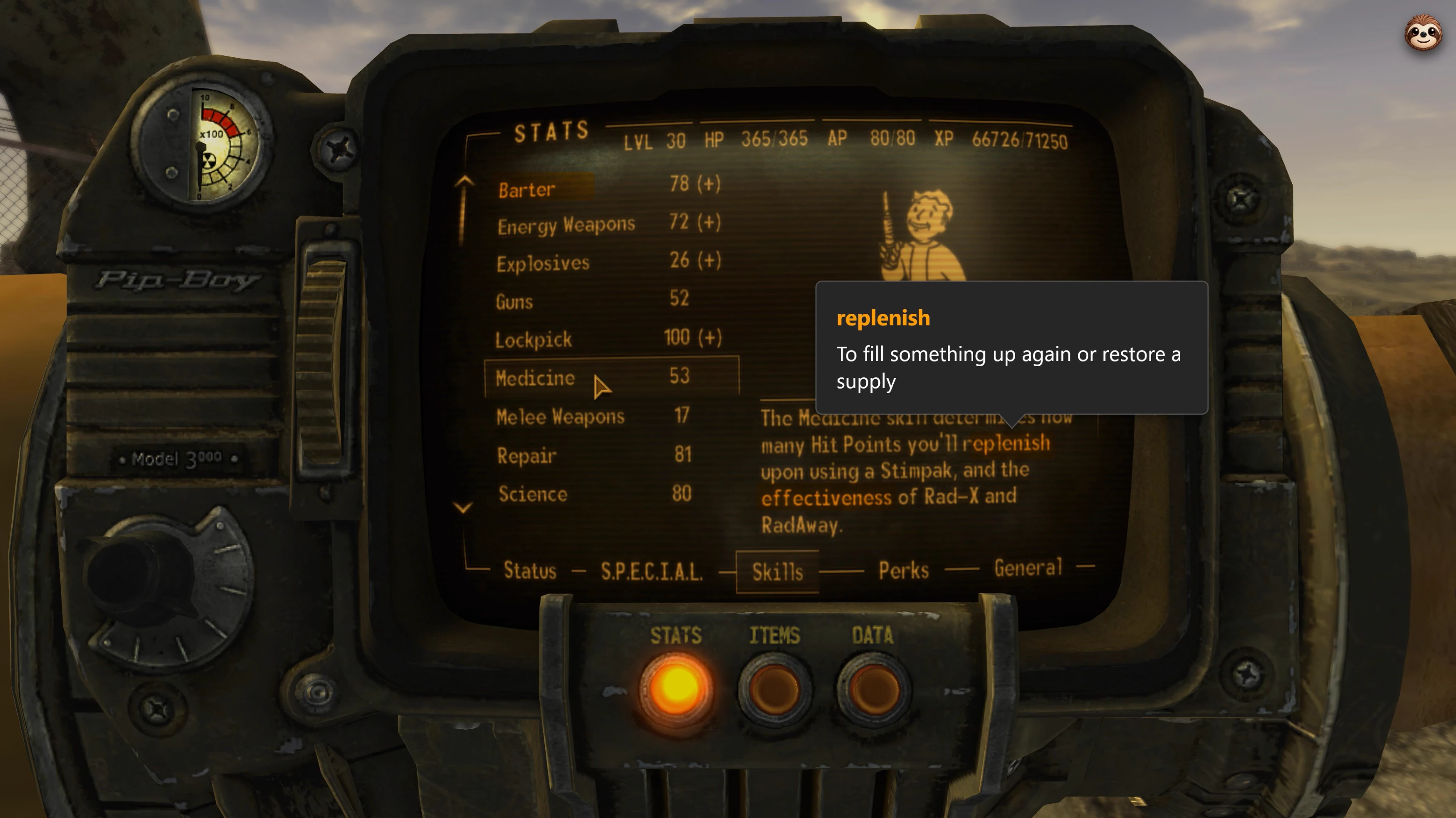
If an explanation is still too difficult, click the reverse icon in the bubble to switch to a translation. Close the overlay and make the choice while the conversation is still fresh.
Use the shortcut at calm reading points: dialogue responses, quest objectives, notes, and barter screens. Pause before using it during exploration, and never open an explanation while real-time combat is still moving.
If you want to try this loop, use Termy while you play Fallout: New Vegas in English. The goal is not to cover the Mojave in definitions. It is to understand the choice in front of you and return to the game.
Let the consequences do the remembering
The best vocabulary moment in Fallout: New Vegas is not the moment a definition appears. It is the moment you choose a response, hear the answer, and discover what your words changed.
Do not wait until your English feels ready for every faction speech, casino rule, and wasteland threat. Turn on subtitles, read the situation first, check the phrase that blocks you, and choose. The Mojave will supply the consequences—and consequences are difficult to forget.
Fallout, Fallout: New Vegas, Bethesda, and Obsidian are trademarks of their respective owners. This independent language-learning guide is not affiliated with or endorsed by Bethesda Softworks or Obsidian Entertainment.
Understand the English choice, make your decision, and keep moving through the Mojave.
Try Termy free with Fallout: New VegasBack to all articles