
This guide is for players who know some English but hesitate to play Trails in the Sky without a translation. It shows how to follow the story, learn expressions you can use beyond the game, and enjoy the playthrough without translating every line. You do not need a translator's degree; the English you learned at school and the willingness to give it a try are enough to begin.
Trails gives you plenty to read, and voiced lines also let you hear English while you follow the story. Characters, images, and later replies help you work out what a line means; repeated phrases get another chance to make sense. That is language immersion here: staying with English as you play and checking a word when the scene cannot explain it.
Tip 1. Learn to think in English
 Zoom
Zoom
Learning to think in another language is a bit like getting used to a new kind of game. When you first play a Trails game, you have to figure out how quartz and slots work. After a while, you can build combinations that clear out the monsters around you without thinking through every slot from scratch. English works much the same way. At first, the text looks like a row of separate words to translate. With practice, you begin to catch the main point before you even reach the end of the sentence.
You need three ingredients for that:
- A grasp of basic grammar, so you can find the main parts of a sentence and follow how they fit together.
- Some vocabulary. More helps, of course, but you can manage with less than you might think.
- Plenty of reading. JRPGs in general, and Trails in particular, give you a lot of it.
Let's talk about grammar first. You do not need to recite all twelve English tenses. During a game, it matters much more that you can see the core of a sentence: who does what, and what follows from it. The situation can fill in the rest.
Take this line:
So don't dwell on things you can't change.

Its core is don't dwell on things: don't keep turning those things over in your mind. The second half tells you which things. You can imagine an omitted that between things and you: things that you can't change. English often leaves that word out in speech.
Here are a few grammar patterns that come in handy:
1. If, unless, as long as, and even if introduce a condition. When you see one, find out what will happen and under which condition.
2. Because, since, although, and while connect a reason, a contrast, or events happening at the same time. In a long line, they work almost like road signs.
3. Be plus a past participle often means that something was done to a person or thing. The road was blocked tells you what happened to the road, even if it does not say who blocked it.
4. Must / might / could / should + have + past participle is often about the past, judged after the event. Consider: One misstep, and it could have been a disaster. Here could have been means it might have ended in disaster, but it did not. The first word changes the meaning:
- Must have happened means the speaker is almost certain it happened.
- Might have happened means it is possible it happened.
- Could have happened means it was possible.
- Should have happened means it was expected, but probably did not happen.
This pattern comes up when characters discuss past events, guess what happened, or regret a decision.
5. Used to and be used to look almost identical, but they do different jobs:
- Used to + verb describes something that happened regularly in the past but no longer does.
- Be used to + noun or -ing means to be accustomed to something.
- Get used to means to become accustomed to something.
For example, There used to be a checkpoint here means there was one in the past. I'm not used to being treated like this means this treatment feels unfamiliar. You'll get used to it means it will become familiar.
Tip 2. Work out unfamiliar words from context
Most of the time, you will not know every word in a line, and that is fine. When you meet an unfamiliar word, you do not have to panic or open Google Translate immediately. The words around it, or the next sentence, will often give you the point.
Take this warning:
It's riddled with old traps and rife with monsters. Be on your guard.

Suppose riddled with and rife with are new to you. You still know old traps, monsters, and guard. You can tell that the place ahead is dangerous, and the last sentence is a warning. That is enough to keep playing.
Set phrases are harder. You may know every individual word and still get nonsense from a literal reading. Butter me up, for example, has nothing to do with butter here: it means to flatter someone, often because you want something from them. If familiar words refuse to form a sensible sentence, check the whole phrase.

I open a dictionary in three cases:
- Without the word, I cannot tell what happened or where to go next.
- An expression keeps coming back, but I still do not understand it.
- A literal reading contradicts what is happening on screen.
The rest of the time, an approximate meaning is enough. If you understand that someone is warning you, expressing doubt, or asking for help, the English line has done its main job. You do not even need to form an exact translation in your first language. That is how the habit of translating every word begins to fade.
The picture often helps too. Imagine seeing this line:

You do not know drench, but it is raining, and the soldier suggests getting home before you... get soaked! If get drenched brings to mind rain and wet clothes directly, without a word in your first language in between, you have reached a new level of understanding.
Tip 3. Termy
Working out words from context works for me roughly 70–80% of the time. In the harder cases, I need another tool. Since I want to enjoy the game as much as possible, I do not recommend switching to a translator with Alt + Tab or typing a word into Google Translate on a phone. There are a few reasons:
1. A translation without the sentence around it can easily choose the wrong meaning.
2. Translating everything switches your thoughts back to your first language. Later, when you try to recall the English word, you may find yourself going through that translation first. Over time, that extra step can slow you down.
3. Switching windows and typing breaks your attention away from the game.
That is why I use Termy.
In the game, I press Alt + X (or the PS button on a DualSense). The game pauses, difficult words and expressions on screen are highlighted, and I can read an explanation right over the game. The definitions match the language level I chose, so they are usually easy to follow. If I still need help, I can switch to a translation.

Tip 4. Listen to English speech
I completely understand choosing Japanese voices in a Japanese game. If you also want to practice listening to English, though, choose the English voice track. You may like it less than the Japanese one, but you will hear English speech while seeing how its words are written.
There is a catch with voices and subtitles: the text pulls your attention toward it. If a scene is voiced, try not to read the line straight away. Listen and look at the characters first; if you miss some words, read the text afterward. That way, you get practice with both listening and reading.
As a bonus, you may spend more time looking at the game's gorgeous art and less time staring at the text.
Tip 5. Learn set phrases as whole pieces
A large part of everyday speech is made of familiar set phrases. The more of them you recognize, the easier it becomes to follow both text and spoken English.
It helps to learn the whole phrase. Knowing come and hand separately does little to explain come in handy. Together, the words mean “prove useful” or “be useful when needed”:

The verb can change while the phrase stays recognizable: came in handy means it was useful, should come in handy means it should be useful, and might come in handy means it could be useful. After meeting that pattern a few times, you begin to read it as one piece.
Some phrases suffer badly from a word-for-word translation:
I can't help but wonder...
Can't help but is not about helping someone. The whole pattern means you cannot stop yourself from doing something: “I can't stop wondering...” Once you know it, you can also understand I can't help but worry and I can't help but laugh.
Another common one is make sure:
Make sure to bring Joshua next time.
Depending on the situation, make sure may mean “be certain to do it,” “don't forget,” “check,” or “see to it.” There is no need to find one fixed translation that fits every use. What matters is the speaker's intention: they want that action to happen.
You do not have to memorize a long list of expressions before playing. Notice the phrases that appear often in dialogue and try to remember the whole piece. I suppose, come to think of it, as long as, there's no need to, you mean: each of these turns several separate words into a familiar pattern. The more you recognize at a glance, the less effort you spend translating.
Build your vocabulary
Anki is probably the best-known app for remembering new words. It uses spaced repetition: flashcards come back at intervals chosen to help you remember them as time passes.
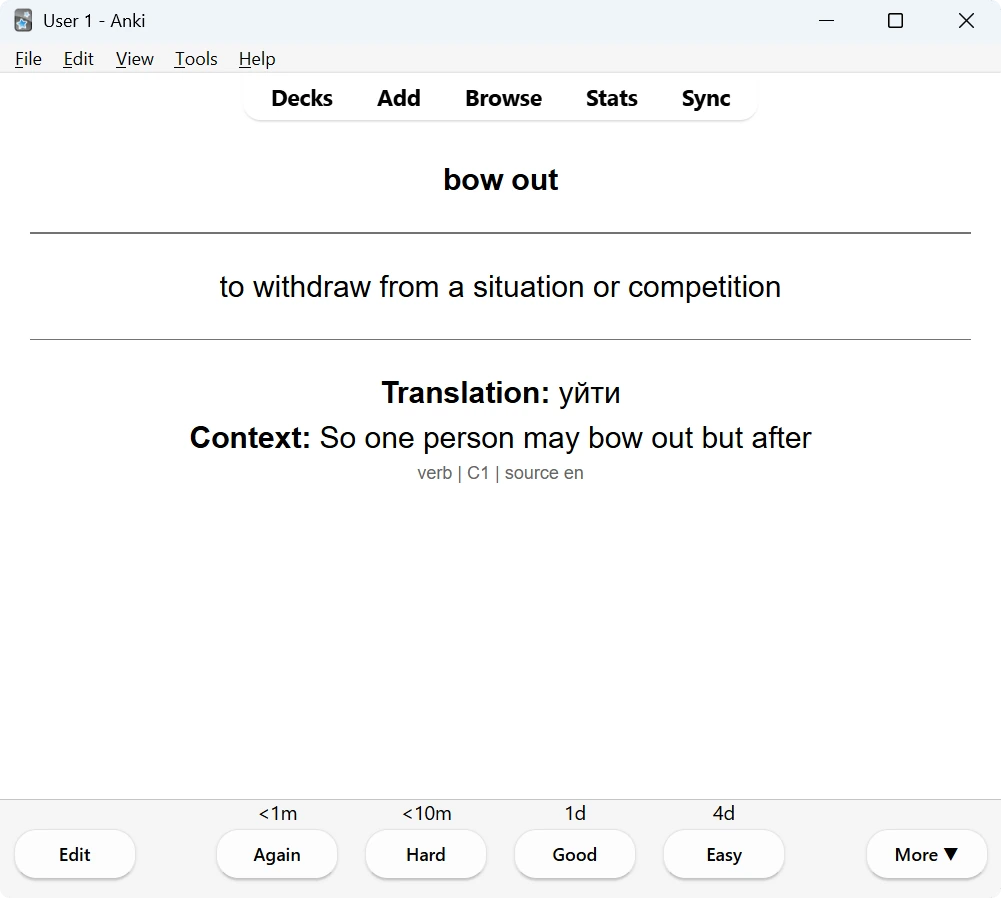
But surely you are not going to add every word by hand? Each word you check with Termy is added to its vocabulary list by default. From there, you can export all of them to Anki, or better yet, choose the ones you actually want to review.
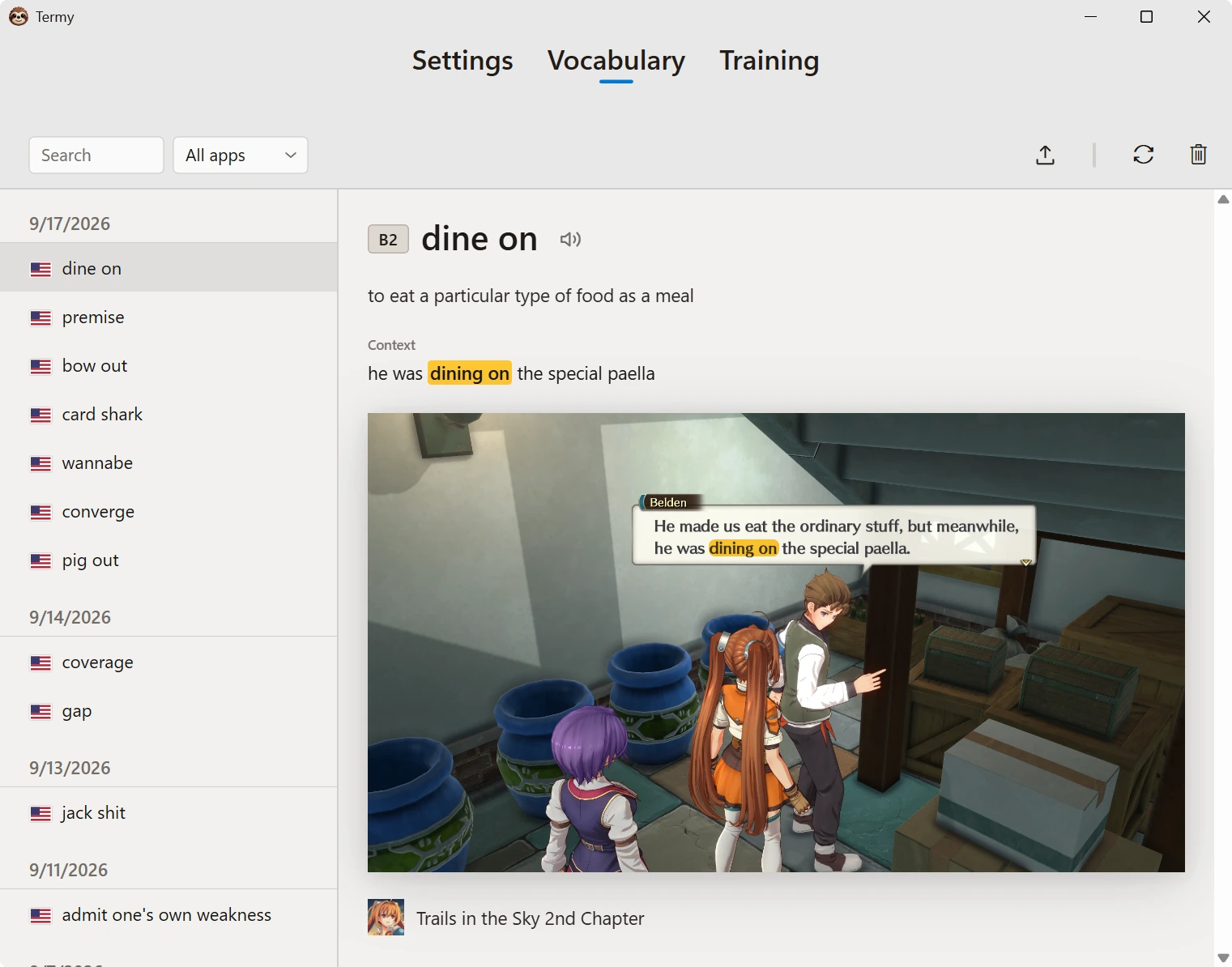
Personally, I never quite made friends with Anki. I prefer practicing inside Termy: it also uses spaced repetition, but gives me more varied exercises.
Conclusion
These skills are useful beyond Trails: in other games, on YouTube, in films and TV shows, and in English-speaking forums and Discord servers. English is a little like a car. When you manage without one, everything seems fine. Once you get used to playing in English, you see how much more freedom you have in choosing what to play and watch, and you understand more of what the creators intended.
So do not limit yourself to translations. Keep learning!
Read also: How to learn English with Dispatch.