
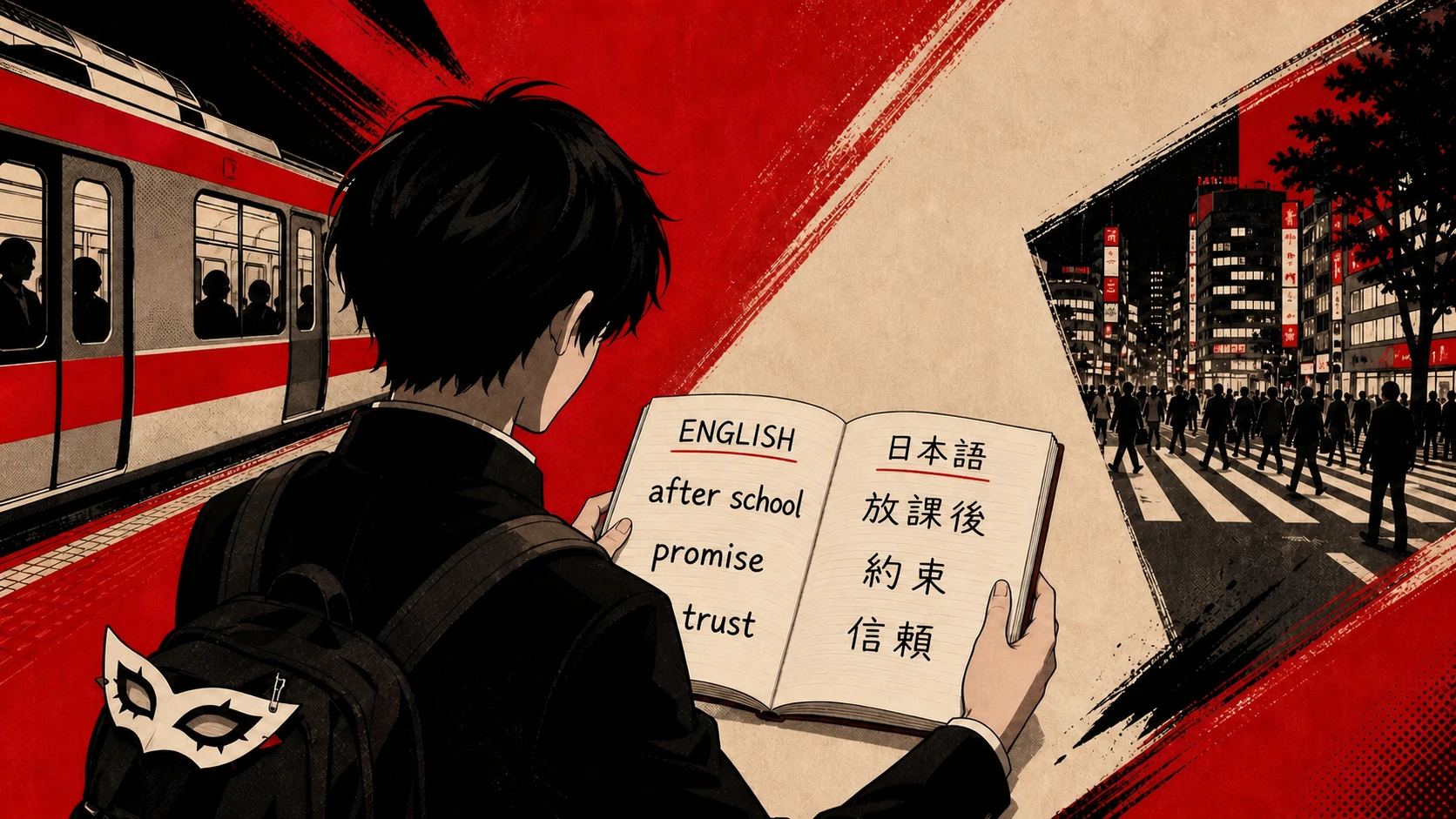
Joker reads almost everywhere in Persona 5. His phone, the station, the classroom, and every Confidant reply all compete for a piece of the same limited day. The calendar makes even a small phrase feel useful.
That pressure can help you learn a language with Persona 5. English and Japanese are the best choices because both have text and full voice tracks. Several well-reviewed translations also support reading practice in other languages. A word matters because it tells you where to go, how a friend feels, or what you are about to spend your limited time on.
Start with English or Japanese
English is the more approachable starting point; Japanese gives you the original script and performances. Set the text language in the game's Steam properties before you launch it, then choose the matching voice track from the title-screen settings. English suits a learner who can follow everyday conversation but still misses slang, jokes, or longer explanations. Japanese asks more of the reader because the text has no furigana, the small kana that show how to read a kanji. Start Japanese after you know hiragana, katakana, basic sentence patterns, and a useful group of common kanji. If you want to learn Japanese with Persona 5, a familiar replay makes the jump easier because you know which scenes deserve slow reading.
Royal rewrote many stiff lines from the original English script, though a few awkward ones remain. The English version still offers plenty of natural conversation, but it is a poor line-by-line guide to the Japanese original. The two scripts often express the same intention in different words. If you pair Japanese voices with English text, listen for mood and familiar phrases rather than trying to match every spoken word to the subtitle.
| Language | Best use | Translation quality |
|---|---|---|
| Japanese | Listening and reading for an experienced learner | The original script and voice track; dense kanji and no furigana |
| English | Listening and reading from an intermediate level | Royal improved much of the earlier stiff localization, but some uneven lines remain |
| Italian | Reading with English or Japanese voices | Italian reviewers praised both the translation and adaptation |
| French | Reading with English or Japanese voices | A strong translation overall, with some grammar mistakes and English words left in place |
| Simplified Chinese | Reading with Japanese voices | The mainland localization was praised for natural wording and rebuilt local puzzles |
| European Spanish | Reading for learners who want Spain's vocabulary and slang | Lively and well adapted, with a few literal reply choices and display errors |
| German | Reading practice when accuracy matters more than tone | Technically sound but often flatter and more awkward than the English text |
| Traditional Chinese | Reading with Japanese voices | Royal improved consistency and local wording, though some typos and rough lines remain |
These translations are reading-first choices because they do not have matching full voice tracks. Use Japanese audio for the original performances, or English audio when following the scene by ear feels easier. Neither voice track will match the translated sentence word for word. Read the target text for meaning, and let the voice carry the emotion and timing.
Let Tokyo teach the common words
The ordinary half of Joker's life carries the language you are most likely to meet again. Phone messages repeat words for plans, time, invitations, and apologies. School brings dates, rules, clubs, tests, and the change between formal speech and the casual language used by close friends. Shops connect verbs to visible actions such as buying, selling, ordering, and choosing. The calendar gives phrases like “after school,” “tomorrow,” “on time,” and “too late” a real cost. You do not need to collect these lines; the next train ride or group chat will bring many of them back.
Follow one useful thread during each in-game day. You might pay closer attention to every message that arranges a meeting, or read the shop prompt before you confirm a purchase. A classroom question can contain specialist words that never return, so take the answer and move on when the topic does not interest you. Confidant scenes deserve more care because the same person keeps a recognizable way of speaking. Notice who speaks politely, who shortens words, and who sounds rough or playful. Those differences teach character and relationship as well as vocabulary.
Palaces and Mementos bring more crime, battle, and fantasy language. Learn the commands that affect an action, especially words for danger, weakness, escape, and investigation. A rare Persona name or occult term can remain a name unless you are curious about it. Most words that travel beyond the game come from daily Tokyo. Palace pressure simply makes a few of them hard to forget.
Use the dialogue log before a dictionary
Persona 5's conversation log is the most useful reading tool already inside the game. Open it when a line vanishes before you finish, when a pronoun hides who is being discussed, or when a choice depends on the last few messages. Read the whole exchange once before separating a difficult word from it. The speaker, portrait, place, and previous reply often remove half the possible meanings. If a logged line has voice audio, play it again and match the sound to the text. One replay is usually enough; repeating every voiced line soon makes a good scene feel stalled.
Try listening first during a short, familiar exchange when your target language has matching voices. Let the voice finish, guess the speaker's intention, and use the text to confirm it. In an unvoiced Confidant scene, slow down for the end of the sentence because it often carries the decision, doubt, or request. The log also gives you time to compare two similar replies without rushing. Pay extra attention when one answer sounds warm and another sounds distant, since both may share most of their words. You can let minor jokes or decorative battle text pass when the scene is already clear.
The log cannot rescue every screen. Battle labels, pop-up notices, and highly styled menu text may disappear outside a normal conversation. Read those through the action they control: confirm, cancel, equip, use, or leave. When the same label returns, the repeated result becomes part of its meaning.
Keep the words that survive both sides of the calendar
The most useful Persona 5 vocabulary works in daily Tokyo and the Metaverse. A word such as promise can describe a serious agreement or an appointment after school. Verbs for inviting, refusing, checking, and deciding return because Joker keeps making plans. Words for rumors, evidence, and trust also appear in other games, films, news, and everyday conversation. The Japanese reading appears beside each English word below; learners using another localization can watch for the same idea in their target text.
| English | Japanese | Where it helps |
|---|---|---|
| after school | 放課後(ほうかご) | Calendar plans and messages |
| contact / message | 連絡(れんらく) | Phone conversations |
| talk something over | 相談(そうだん) | Confidant talks |
| promise / appointment | 約束(やくそく) | Plans and serious conversations |
| invite | 誘う(さそう) | Free-time choices |
| refuse / turn down | 断る(ことわる) | Replies and requests |
| make it in time | 間に合う(まにあう) | School and travel |
| be late | 遅刻(ちこく) | School and appointments |
| companion / teammate | 仲間(なかま) | Friends and battles |
| trust | 信頼(しんらい) | Relationships |
| rumor | 噂(うわさ) | School and investigations |
| incident / case | 事件(じけん) | News and story discussions |
| evidence | 証拠(しょうこ) | Investigations |
| check / investigate | 調べる(しらべる) | Prompts and plans |
| danger | 危険(きけん) | Palaces and warnings |
| choose | 選ぶ(えらぶ) | Menus and decisions |
Do not memorize the table before playing. Notice one word when the game gives it a job, then watch for it later. Keep the full phrase around a verb when possible, because the surrounding words show who is inviting, trusting, or refusing whom. A word earns extra attention when it returns in another part of Tokyo or changes a choice. One-off mythology and weapon names can wait unless that subject is part of the fun for you. A smaller group of words tied to clear scenes will be easier to recognize than a long list copied from every menu.
Check one blocking word, then answer
Some lines stay unclear even after you use the portrait, the scene, and the conversation log. Check a word when it hides a request, changes the tone of a reply, or blocks the next action. Leave it alone when you can already tell what the speaker wants and what your answer will do. This keeps the interruption connected to a decision you care about.
A phone dictionary works well while the dialogue log is open. If changing windows breaks the scene, Termy can explain the difficult word on the game screen and use the surrounding line as context. Read the short explanation, return to the choice, and let the word prove itself if it appears again. Tilted labels or text over a busy battle effect may be hard for any screen translation tool to capture, so use clean dialogue boxes and message screens when you can.
Give important Confidant replies more time than a vending-machine prompt. Let a Palace keep its pace when the action already explains the command. Save a word only when you would enjoy meeting it again; a full vocabulary list can wait until after the credits. Persona 5 has more Japanese than anyone needs to master in one run. Following Joker's day, understanding a little more, and still wanting to play tomorrow is enough.
Related: How I Learned English with JRPGs.
Termy explains hard words on your game screen, using the line around them for context.
Try Termy FreeBack to all articles