

Playing Gothic 1 Remake in German gives you repeated listening and reading practice inside a story you already want to follow. Words return in quests and conversations, while the characters, setting, and consequences help you work out what those words mean.
That combination can build vocabulary, improve listening, and help you follow German without translating every sentence in your head. The point is not to understand every line. It is to understand enough to choose, act, and keep exploring the Colony.
Gothic is unusually well suited to this. It began as a German project, and the remake's German voice-over was created as its own version instead of as a direct translation of the English script. The characters may use different phrasing while still reaching the same outcome. You hear the Colony's rough tone while learning the language of orders, deals, debts, and quests.
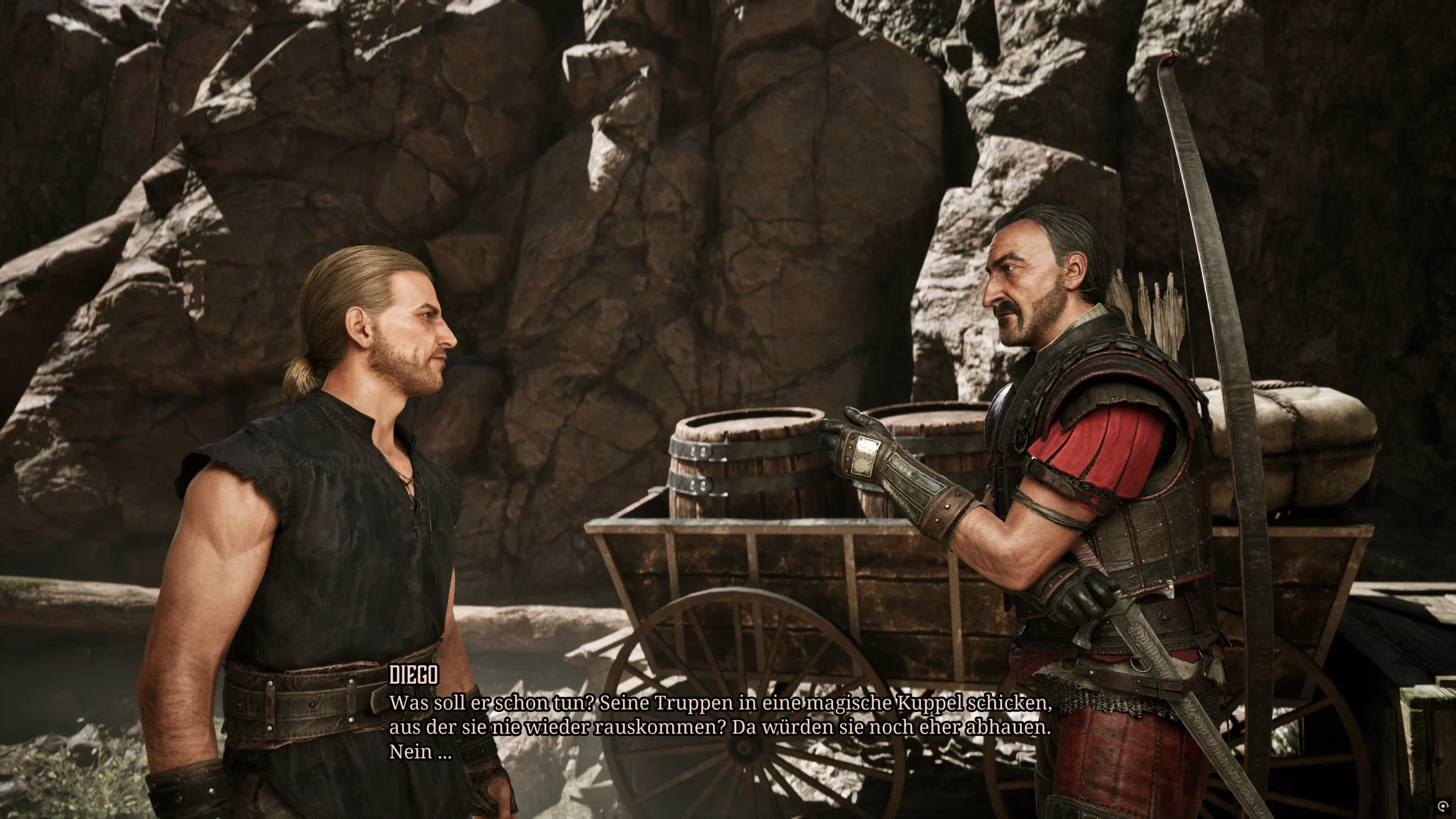
Your first session at a glance
| When | What to do | What you gain |
|---|---|---|
| Before playing | Set German text, voices, and subtitles | Connect the spoken and written language |
| For 35 minutes | Follow the scene and check only blocking expressions | Keep the story moving while still learning |
| For 5 minutes | Review the few expressions you checked | Focus on language that mattered in play |
| For 5 minutes | Retell the last scene in simple German | Turn recognition into active use |
B1 is a comfortable starting point. At strong A2, begin with shorter sessions and expect to check more words during the first few hours. Missing part of a line is normal. If you still know who wants what and what you need to do, you understand enough to continue.
Why Gothic works for German practice
Gothic 1 Remake officially supports German interface text, full German audio, and German subtitles. More importantly, the language constantly helps you do something. Guards give orders. Traders want ore. People threaten you, ask for help, lie, and argue about which camp deserves your trust.
The German version also has a reason to sound natural in this world. In THQ Nordic's feature on the localization, German voice director Tim Henneman explains that the team created its own German voice-over rather than translating the English line by line.
This gives you a useful mix: everyday verbs such as kommen and geben, practical language for joining, paying, helping, and persuading, and memorable fantasy vocabulary tied to the Colony. Learn the language that helps you act, choose, and follow the story. Let decorative lore pass unless it keeps returning.
Set up Gothic 1 Remake in German
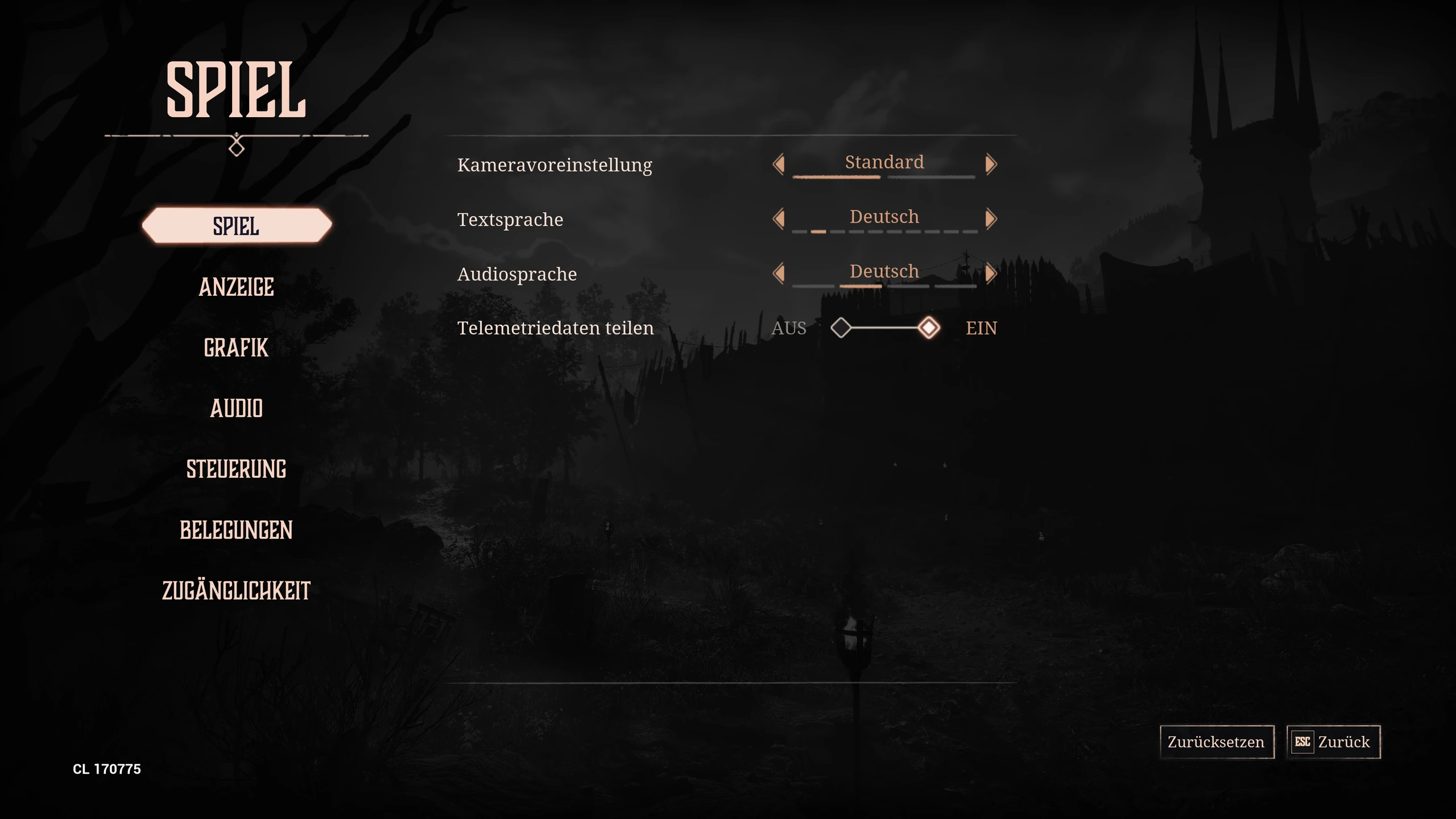
- Open Spiel in the settings.
- Set Textsprache to Deutsch.
- Set Audiosprache to Deutsch.
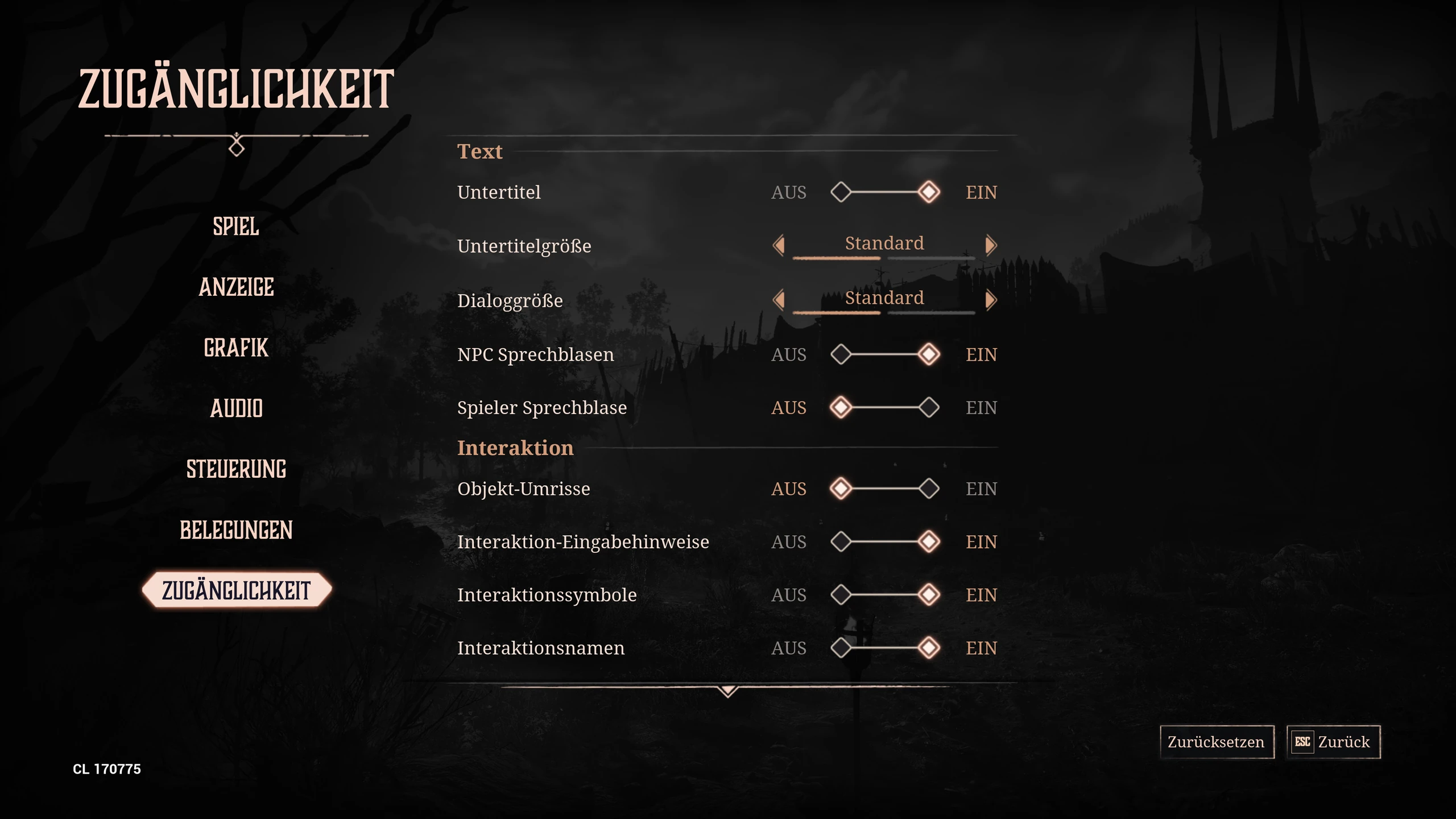
- Open Zugänglichkeit and set Untertitel to Ein. If the interface is still in English, choose Accessibility → Subtitles → On.
- Increase Untertitelgröße or Dialoggröße if the text is difficult to read.
Keep both the text and audio in German. Hearing a line while reading it helps you match sound to spelling. German audio with English text is less useful because your eyes will usually choose the easier English.
Use the read–think–check–return method
1. Read and listen first
Let the character finish speaking. Read the German subtitle and inspect the scene before reaching for help. The speaker's expression, location, and relationship to you often reveal more than an isolated dictionary entry.
2. Decide what the line is doing
Ask three questions:
- Who wants what?
- Is this an order, offer, warning, threat, joke, or ordinary information?
- Can I still choose a reply or follow the quest?
If you can answer those questions, continue playing. You do not need to solve every unknown word.
3. Check only the blocking part
Check a word or phrase when it changes a choice, blocks a quest instruction, or keeps returning. At strong A2, a bilingual dictionary is usually the fastest route to the missing meaning. At B1, try a German learner's dictionary when the definition is easy enough to follow.
Avoid translating the complete subtitle by default. A full translation is easy to read, but it does the useful work for you. Find the missing piece, fit it back into the scene, and keep the German sentence in front of you.
4. Return to the scene
Close the dictionary or explanation and continue. Save grammar research and longer review for after the session. The story is what gives you enough German contact for the method to work.
A real example: one word changes the choice
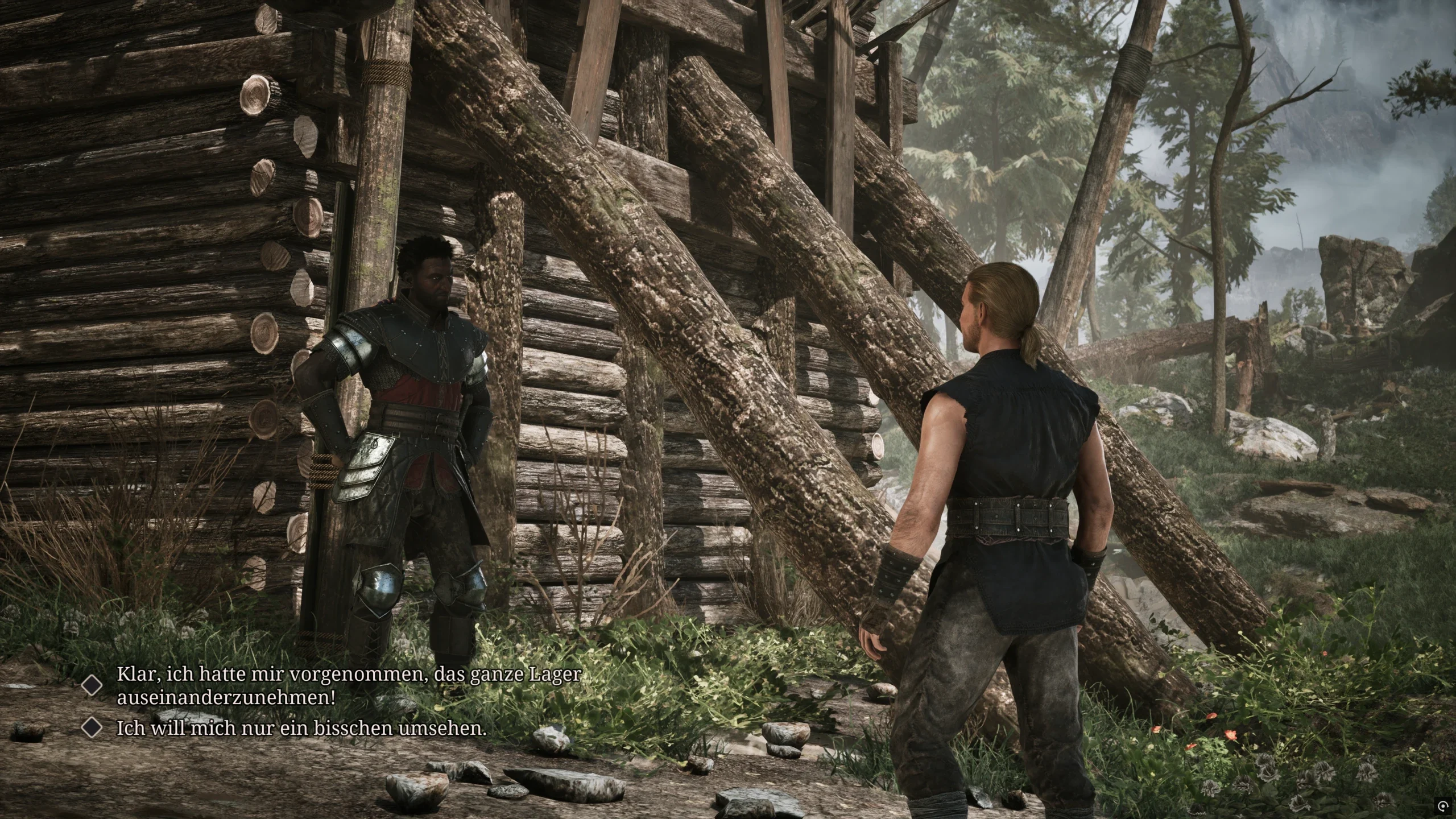
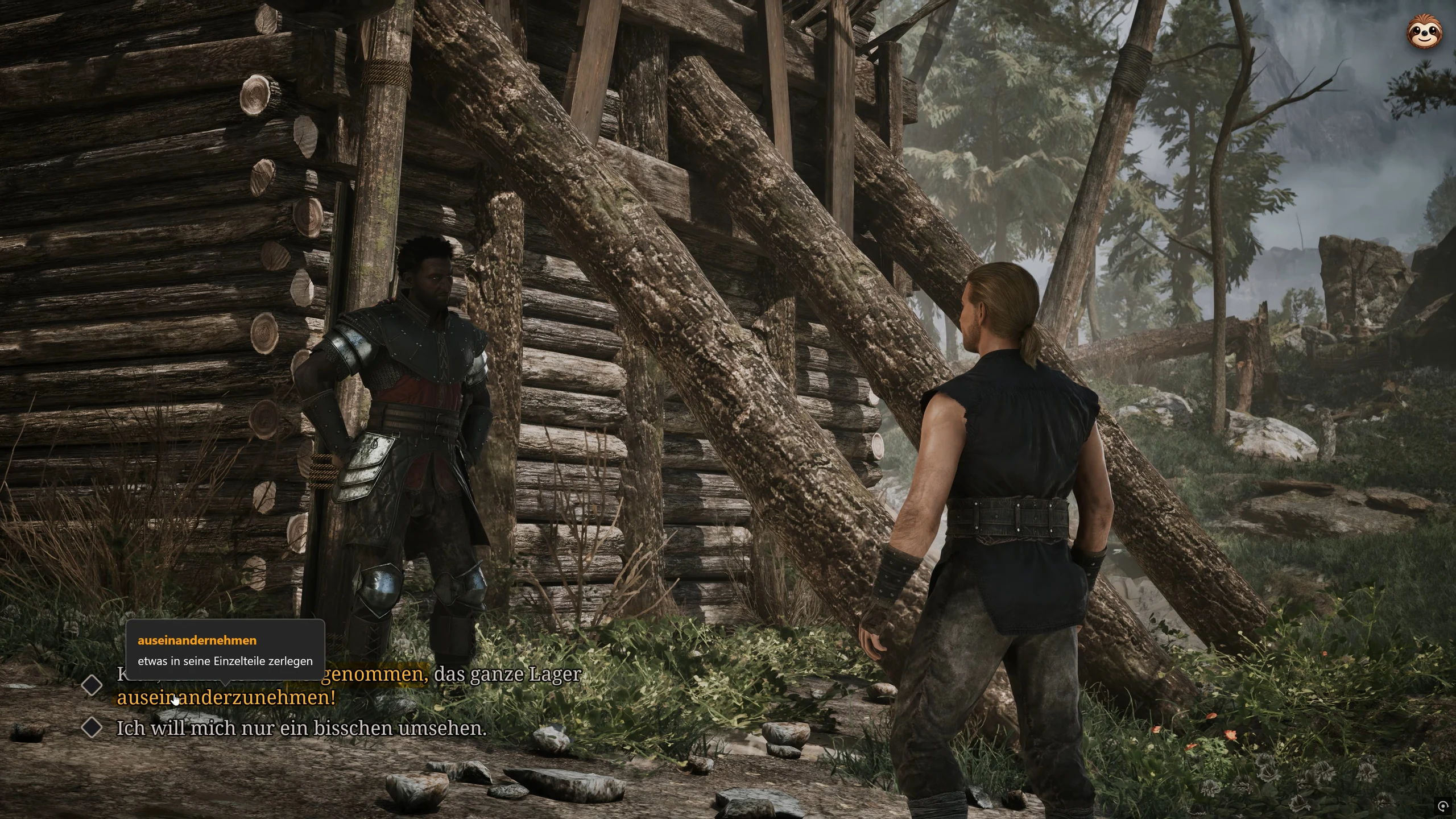
In this scene, the first response contains:
… das ganze Lager auseinanderzunehmen!
auseinandernehmen literally means to take something apart. Applied to an entire camp, it suggests tearing through or wrecking the place. The other reply—Ich will mich nur ein bisschen umsehen—means that you only want to look around.
You do not need to analyze the whole sentence. Once auseinandernehmen makes the contrast clear, you can choose the tone you want and return to the conversation.
German to learn first in the Colony
Start with language that helps you act and follow relationships. These words are useful beyond a single line:
| German | Useful meaning | Why it matters |
|---|---|---|
| der Auftrag | assignment; order | Often functions like a quest or task |
| das Lager | camp | Camps and their relationships shape your choices |
| das Erz | ore | A central resource and payment concept |
| die Wache | guard; watch | Can describe a person or guard duty |
| handeln | to trade; to act | Context distinguishes commerce from taking action |
| sich anschließen | to join | Useful when people discuss groups and loyalties |
| jemandem etwas schulden | to owe someone something | Helps with debts, favors, and obligations |
| jemanden überzeugen | to persuade someone | Signals that a conversation can change a decision |
Commands worth recognizing quickly
- Pass auf! — Watch out! / Listen carefully!
- Hau ab! — Get lost! / Go away!
- Komm mit! — Come with me!
- Lass mich in Ruhe! — Leave me alone!
- Gib das her! — Hand that over!
- Das geht dich nichts an. — That is none of your business.
These are common German patterns, not a transcript of the game. Learn them as complete expressions so you can recognize the intent before analyzing every word.
Three German patterns that help you keep reading
Separable verbs split in normal sentences
Dictionaries list verbs such as aufpassen, abhauen, abgeben, and anschließen. In a normal sentence, the prefix often moves to the end:
- Pass auf. — Pay attention.
- Hau ab. — Get lost.
- Gib das Erz ab. — Hand in the ore.
- Ich schließe mich dem Lager an. — I am joining the camp.
Small endings show relationships
Notice how small changes help connect people, places, and obligations: mit dem Händler sprechen (speak with the trader), bei einem Lehrer lernen (learn from a trainer), and jemandem Erz schulden (owe someone ore).
You do not need to name every grammatical case while playing. First notice which person or group is involved. Study the rule later if the pattern keeps blocking you.
Split long compounds from the right
- Erzbrocken = Erz + Brocken — ore nugget
- Schutzgeld = Schutz + Geld — protection money
The final part tells you what the object is. An Erzbrocken is a kind of Brocken; Schutzgeld is a kind of Geld.
What to save and what to skip
| Situation | Best action |
|---|---|
| The expression changes a choice or quest action | Check it now |
| The expression keeps returning | Check it and review it later |
| You understand the line without it | Keep playing |
| It is a proper name or one-off creature | Usually skip it |
| It is decorative lore that does not affect the scene | Let context carry it |
Save less than you think you should. A short list of expressions tied to clear scenes is more useful than a large list you never revisit.
Complete one 45-minute learning session
- Play for 35 minutes. Stay in German and check only expressions that block an action, choice, or repeated useful idea.
- Review for 5 minutes. Revisit the few expressions you checked. Recall the person and situation before reading the meaning again.
- Retell the scene for 5 minutes. Use simple German. Four sentence starters are enough:
- Ich habe ___ getroffen. — I met ___.
- Er/Sie wollte ___. — He/She wanted ___.
- Ich musste ___. — I had to ___.
- Als Nächstes werde ich ___. — Next I will ___.
Your German can be rough. Retelling turns words you recognized into words you try to use. Adjust the times before the game starts to feel like homework.
This routine is a modern version of how Termy's founder learned through games: read first, use context, check only what blocks you, and return to the story. You can read the full story in How I Learned English with JRPGs and a Paper Dictionary.
A more comfortable way to get unstuck
Termy is a desktop language-learning app that pauses your game, recognizes the visible text on your device, and gives you short explanations of difficult words and phrases. It can also keep useful vocabulary connected to the original sentence and screenshot context for later practice.
On Windows:
- Set German as the language you are learning in Termy.
- When a subtitle, choice, or quest description blocks you, press Alt + X.
- Termy pauses the game, recognizes the visible text, and explains the terms most likely to be difficult at your level.
- While the overlay is open, click any other word you want to understand. If that word belongs to an idiom or fixed expression, Termy selects and explains the complete phrase.
- Close the overlay and continue playing.
Termy also has a translation mode. Both modes work with individual words and phrases rather than translating a whole paragraph. Explanation mode describes the term in simple German, which keeps you thinking in the language you are learning. Translation mode gives the meaning in your own language. Start with explanations and use translation when the German explanation is still unclear.
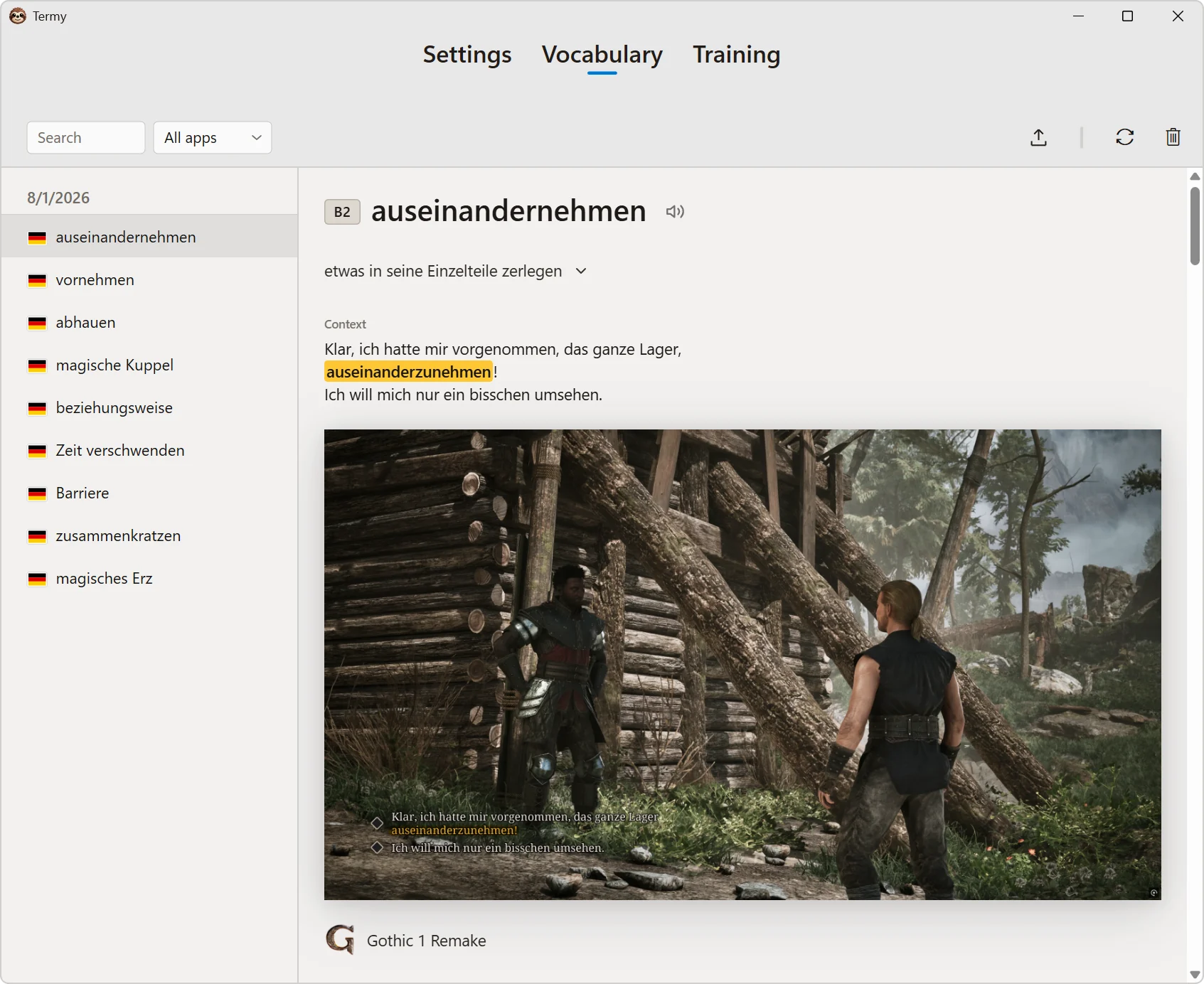
If you want to follow the same method with fewer interruptions, try Termy while you play Gothic in German.
Start with one session
Do not wait until your German feels ready for the entire game. Set Textsprache and Audiosprache to Deutsch, turn on Untertitel, and play for 35 minutes. Use context before reaching for help. Keep no more than five expressions from that session.
Your goal is not to understand every line. If you knew who wanted what, made your choices, and followed the next quest step, the session worked. The Colony will repeat much of its useful language. Each word you recognize without checking it again makes the next conversation easier.
Gothic 1 Remake and Gothic are trademarks of their respective owners. This independent language-learning guide is not affiliated with or endorsed by Alkimia Interactive or THQ Nordic.
Keep the German sentence in front of you, get the missing meaning, and return to the Colony.
Try Termy free with Gothic 1 RemakeBack to all articles