

The Last of Us Part I is a good place to learn English because its words usually lead to an action. Give me a boost ends with someone climbing a wall. Keep your voice down matters because danger is close. The game often supplies the meaning before a dictionary could.
The harder skill is knowing what to let pass. Joel often speaks quietly, Ellie uses slang, and battle dialogue competes with whatever is trying to kill you. A good English playthrough follows the scene first and checks only the language that changes what is happening.
Choose subtitles that keep the story moving
The best setup: use the original English voices with English subtitles. Listen first and glance at the text only when you need it. If the English text becomes too difficult, change only the subtitle language.
The other-language voice tracks are much worse than the original English acting. Some lines lose meaning or feeling, and their subtitles do not always match what the actors say.
Use subtitles differently in each kind of scene. During exploration, give the voices a moment before reading. In a fight, read commands such as take cover at once because they tell you what to do. Let quiet side comments pass unless they change your understanding of the scene.
A familiar chapter is a good place to try English subtitles again. You already know where the characters are going and why they are nervous, so one unknown phrase cannot block the story.
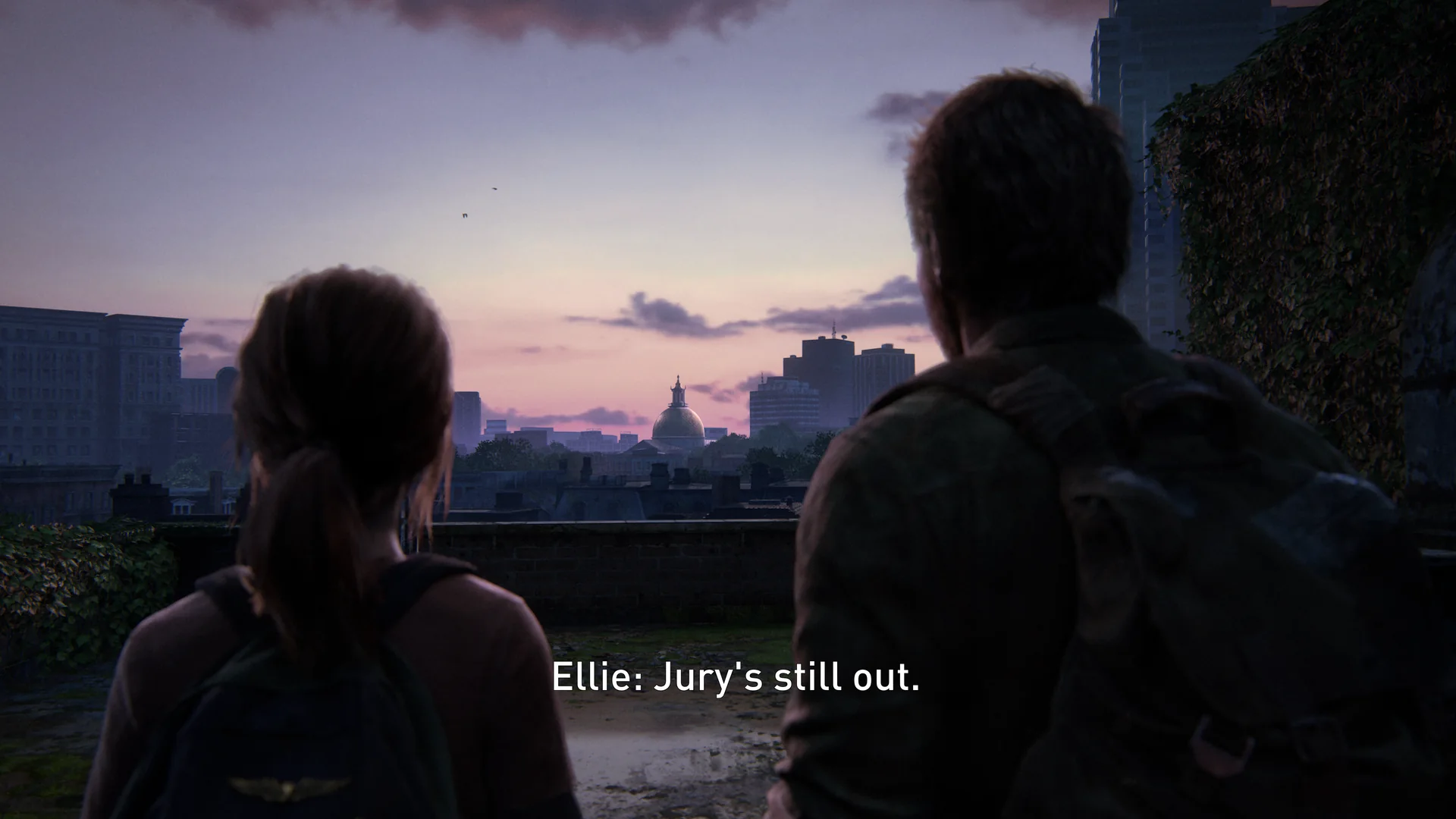
Know when to keep moving—and when to check a phrase
A tense scene is still teaching you when a few words go missing. Fast movement, faces, and the next reply help you guess what the words mean. Pause too often and those clues disappear into a series of frozen frames.
Keep moving when you know what to do and understand how the characters feel. Check a phrase when missing it causes a problem: a verb changes the task, a noun names the object you need, or a phrase changes the meaning of a reply. Everything else can wait for a quieter room.
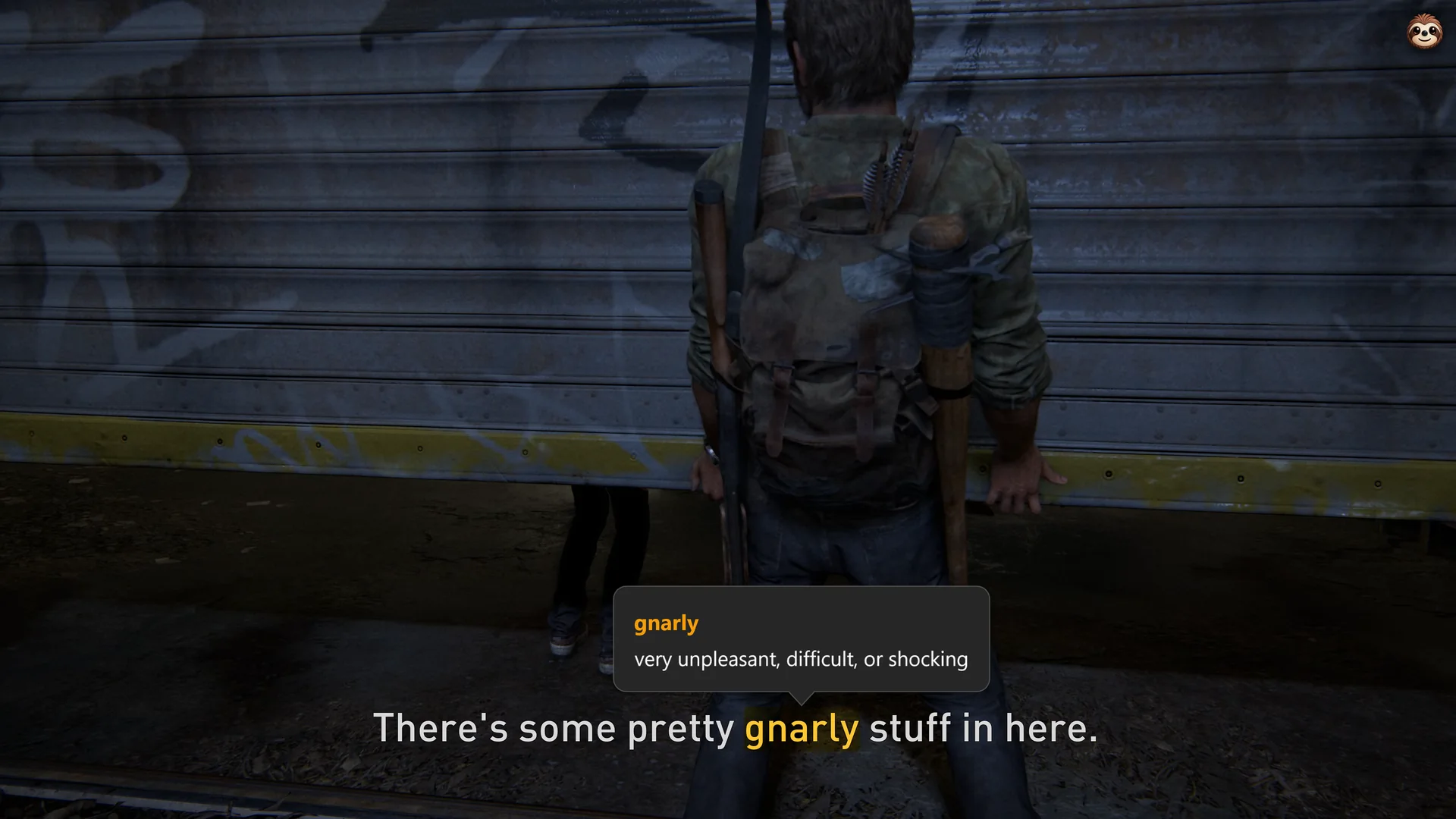
Some slang and common phrases stay hard even when the action is clear. Jury’s still out is not about a courtroom here, and gnarly can be positive or negative. The scene may show the general feeling without giving you the exact meaning. Checking each word separately will not solve an expression such as jury’s still out, and a basic translation may choose the wrong meaning of gnarly.
That is when a short check is worth the pause. In the screenshot below, Ellie says, There’s some pretty gnarly stuff in there. The danger already tells you that gnarly is negative, but you may still not know how bad it is. Press Alt+X. Termy automatically chooses the most difficult words in the subtitle and explains them over the game while the full line stays visible. Once the line makes sense, close the explanation and continue playing.
Let ladders, boosts, and stealth repeat the language
Part I keeps asking the characters to help each other in the same ways. Someone needs a boost, a ladder must be placed, a narrow gap must be crossed, or a path must be cleared. The words change while the action stays easy to recognize. After a few chapters, give me a boost is no longer a phrase you translated; it is simply what happens beside a high wall.
Stealth scenes also repeat the same warnings and movement words. Story + Combat Dialogue subtitles make them easier to notice. You rarely need the whole line. Catch whether an enemy is looking for you, has seen you, is moving around you, or is running away, then react.
Notes, signs, and documents slow time down. Read the whole page when the writing interests you; otherwise take the names, dates, and main warning and move on. Missing one abandoned note will not break your progress—or the story.
Hear Joel’s casual English
You can hear Joel’s Texas background in his slow, stretched accent, his rhythm, and the way he cuts some endings short. Most of his words are common casual English. A few lines are worth learning as complete phrases:
- I reckon it takes… means “I think it takes…” Reckon is often heard in the Southern United States and in other places.
- Y’all stay here clearly speaks to more than one person. Y’all is common in the American South and is now heard much more widely.
- I ain’t leavin’ without ya becomes “I am not leaving without you” in standard written English. Ain’t is used in casual speech in many places, but avoid it in formal writing.
- We best rest up shortens “We had better rest.” It means that resting is the smart next move.
Forms such as gonna, gotta, ’cause, ya, ’em, and talkin’ are common far beyond Texas. Learn to hear them in fast conversation, but use the full forms in formal writing.
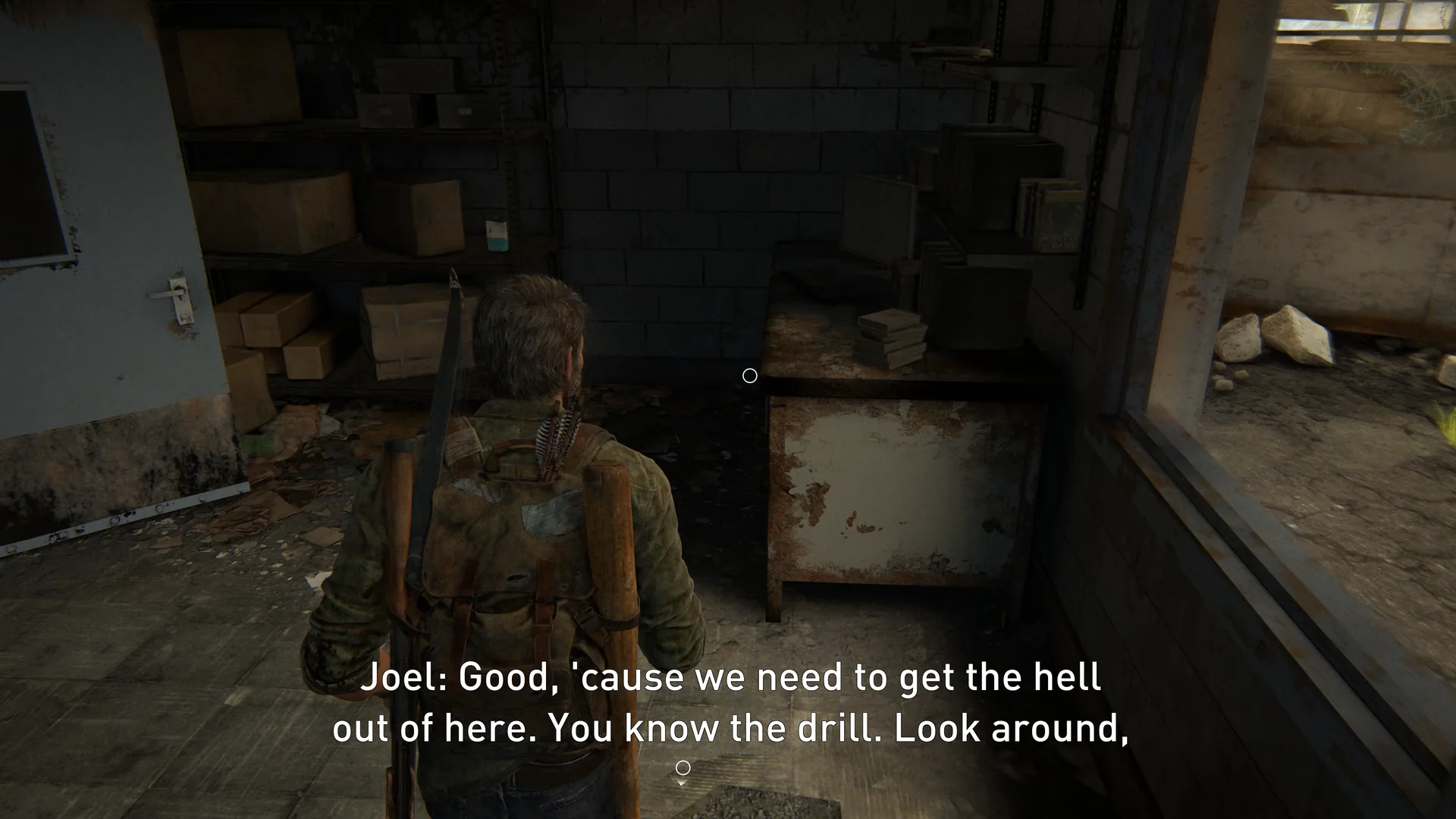
Words worth carrying beyond the quarantine zone
The Last of Us Part I vocabulary often describes limited food and tools, movement, danger, and helping other people. You will meet these words in other games, films, news, and everyday conversation; the monster names can stay inside the quarantine zone.
| Word or phrase | Plain meaning |
|---|---|
| outbreak | A sudden start or spread of disease or violence |
| quarantine | Keeping people apart to stop a disease from spreading |
| ration | A limited amount of food or something else that each person may use |
| supplies | Useful things saved for later |
| smuggle | Move a person or object secretly and against the law |
| infected | Made ill or changed by a disease |
| immune | Protected because a certain disease or danger cannot harm you |
| ambush | A surprise attack from a hidden place |
| take cover | Move behind something that protects you from danger |
| keep your voice down | Speak more quietly |
| squeeze through | Pass through a very narrow space |
| watch your step | Move carefully and notice where you place your feet |
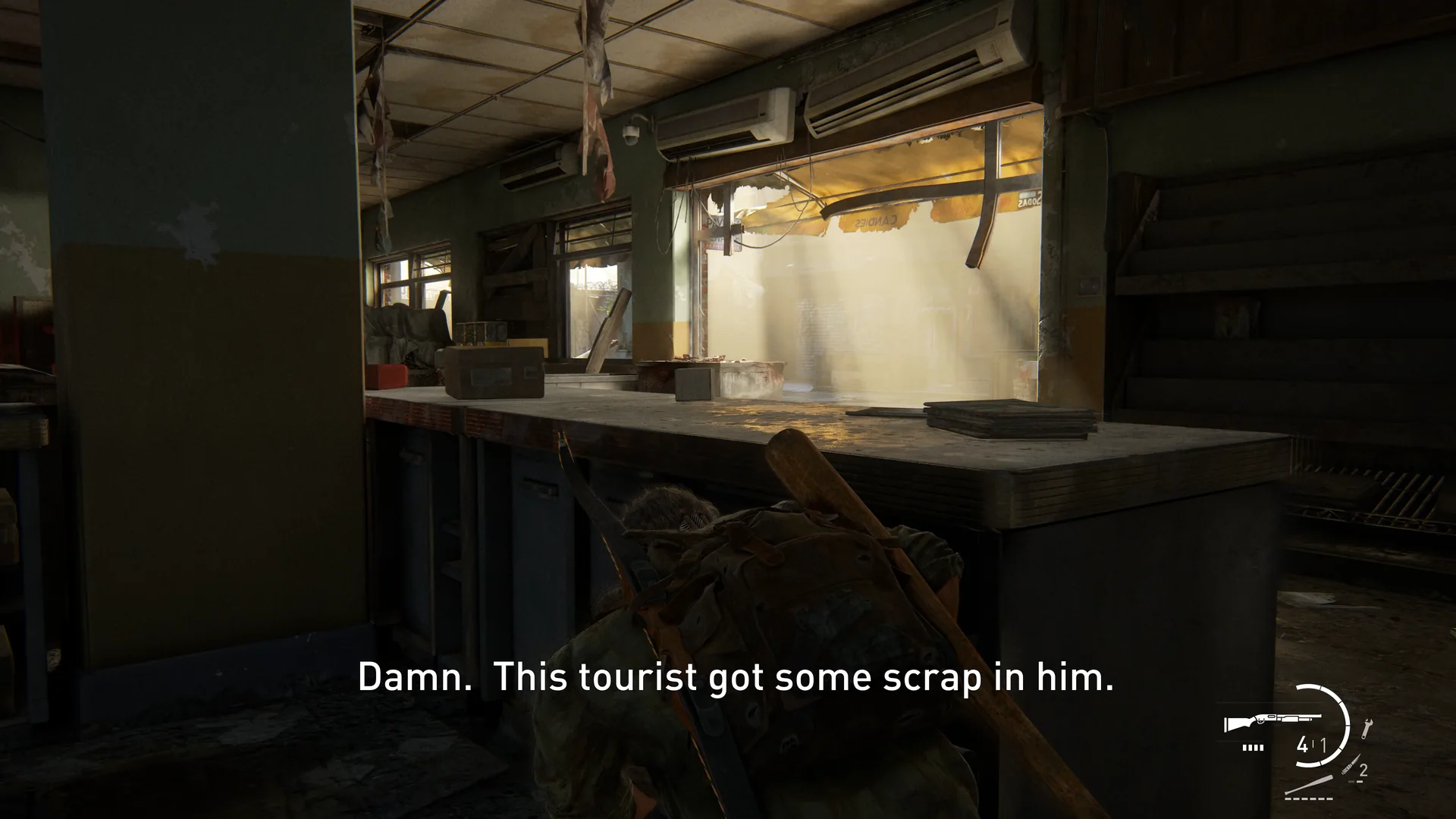
There is no reason to memorize the table before playing. Meet ambush during an ambush or squeeze through while Joel turns sideways between two walls, and the game has already done half the work.
Clear action words are only half of the game’s English. The quiet conversations are often harder than the orders shouted in combat. You can know every dictionary word and still miss whether a character is teasing, refusing, trying to calm someone, or hiding something.
First decide what the speaker is doing: warning, refusing, joking, or hiding something. Then notice the small words that create that feeling: just, still, even, I guess, a question used as a request, or a name used instead of a full reply. These small choices can tell you a lot about the relationship.
Swearing appears often. First learn what a swear word shows—anger, fear, strong feeling, or closeness—before you decide to say it yourself. Understanding a word does not mean it is safe to use. Age, relationships, and danger can all change how it sounds.
Set up the next chapter without making English the enemy
It is hard to read English subtitles while also watching enemies, supplies, and the path ahead. If you keep dying because every subtitle feels like an extra problem, change the game settings before giving up on English.
Part I includes Very Light through Grounded difficulty levels and a Custom option. You can change player damage, enemy and ally strength, stealth, and supplies separately. You can still earn trophies at any difficulty. Change the part that causes trouble: make stealth easier, add more supplies, or reduce the damage you receive.
A lighter combat setting leaves more attention for the warning, the subtitle, and the route ahead. The dialogue stays exactly as difficult; you simply get a fair chance to hear it.
Once the action leaves you enough time to listen, the rest of the setup is simple:
- Choose a section you want to play. A familiar chapter gives you more help, but a first playthrough also works when you can still follow the story.
- Set English audio and English subtitles. Use subtitles in a language you know for a while if the story becomes hard to follow.
- Choose how much dialogue to show. Start with Story + Combat Dialogue. Remove combat lines if the screen feels crowded during encounters.
- Follow actions and feelings. Check only language that changes what to do, where to go, or how one person responds to another.
- Stop at a natural break. If one phrase returned several times, say it once with the scene in mind or save it for later. No review is required before the next chapter.
The setup is working if you finish the chapter wanting to start the next one. Wanting to know what happens next keeps the game in charge, and the English comes along with it.
Termy explains hard words on your screen—in games, movies, and websites. One shortcut. At your level.
Try Termy FreeBack to all articles