

Back in 2015, Life is Strange was not a technical showpiece. Its lip-sync wandered, its animations could be stiff, and some of its dialogue sounded awkward even then.
What the game lacked in polish, it made up for with heart and style. The soft, painterly art direction turned technical limitations into atmosphere. The soundtrack and voice performances gave the game an identity that more expensive productions often fail to find. Contemporary reviews kept returning to the same tension: PC Gamer called it “beautiful, touching and messy,” while GameSpot praised its hazy, memory-like look and natural voice acting.
Its English has the same imperfect charm. This is not polished textbook dialogue. Some slang lands better than other slang, but the voices carry meaning beyond the literal words. For a learner, the most valuable parts are the ordinary expressions that still sound useful after leaving Arcadia Bay.
Spoiler-light content note: this guide avoids major story reveals, but the game is rated Mature 17+ and deals with violence, strong language, bullying, abuse, and suicide.
What makes its English interesting
The dialogue is useful precisely because nobody wrote it as a language exercise. It moves between ordinary phrasal verbs, American slang, emotional vocabulary, and more specialized language. Some lines are sincere, some sarcastic, and some deliberately uncomfortable. A dictionary can explain the words; the performances explain why they were chosen.
That context is what makes phrases stick. Even when I forget an exact subtitle, I can often remember its voice and tone. The rewind mechanic helps too: if a line disappears before it clicks, I can hear it again without leaving the game or turning repetition into a separate exercise.
The journal, messages, and other readable text provide a slower counterpoint to spoken dialogue. I would recommend the game most confidently at B1 or B2. At B1, slang and occasional photography or investigation terms will require help. At B2, the more interesting challenge is tone. A strong A2 learner can still enjoy it by checking only the language that blocks understanding.
Can you learn another language with Life is Strange?
Yes, with one important distinction. English is the best choice if you want to practise listening and reading together. The game keeps its English voice acting in the French, German, Italian, Brazilian Portuguese, Castilian Spanish, and Latin American Spanish versions; those languages replace the interface, subtitles, journal, and messages.
The localizations are complete and generally natural. They often replace an English expression with a real local equivalent rather than translate it word for word: get away with something, for example, becomes s'en tirer in French, passarla liscia in Italian, se safar in Brazilian Portuguese, and salirse con la suya in Spanish. Texting shorthand is adapted too. That makes these versions useful for reading, vocabulary, and informal language, although occasional awkward choices and small errors mean they should not be treated as grammar books.
Because the voices remain English, the translated subtitles will not match what you hear. Choose one of them for target-language reading practice, not pronunciation or listening practice. A separate Japanese release includes Japanese voices and text, but its availability is region-dependent. The examples below use English, but the same check-only-what-blocks-you method works with any of the game's supported text languages.
Six Life is Strange vocabulary examples worth keeping
I chose these because the game gives each one a memorable job. They also travel well: you can use them at school, at work, with friends, or while trying to explain why your weekend went completely wrong.
These look similar, but they describe two different routes to an answer. You figure something out by thinking until you understand or solve it. You find something out when you discover information.
Examples: “I cannot figure out how this camera works.” / “Did you find out who called?”
To hang out is to spend relaxed, unstructured time with someone. It is more casual than arranging an activity: the time together is the point.
Useful patterns: “Do you want to hang out after class?” / “We used to hang out at that café.” Use with for a person and at for a place.
In the game, check out often means “look at this” or “go and examine that.” It can sound casual between friends or purposeful during an investigation. The tone changes; the core idea stays the same.
Examples: “Check out these photos.” / “I want to check out the new bookstore.” With a pronoun, put it in the middle: check it out, not check out it.
To stick up for someone means to defend them when they are being criticized, bullied, or treated unfairly. It usually suggests that speaking up takes at least a little courage.
Example: “She stuck up for me when everyone else stayed quiet.” The past form is stuck up for.
If someone gets away with something, they do something wrong and avoid punishment. The expression often carries frustration because the speaker believes there should be consequences.
Examples: “He lied and thought he could get away with it.” / “You cannot get away with treating people like that.” It can be followed by a noun, a pronoun, or an -ing verb.
Messed up is informal and flexible. A plan can be messed up (spoiled), a situation can be messed up (deeply wrong), and a person can feel messed up (emotionally shaken). The surrounding noun—and the speaker's tone—does most of the work.
Examples: “The storm messed up our plans.” / “What they did was seriously messed up.” Be careful when using it about a person; it can sound harsh and judgmental.
You will also hear conspicuous character words such as hella and wowser. I enjoy them, but I would learn to recognize them before trying to imitate them. They tell you a great deal about this cast and this particular mid-2010s world; the six expressions above are much easier to carry into your own English.
The texts have their own English
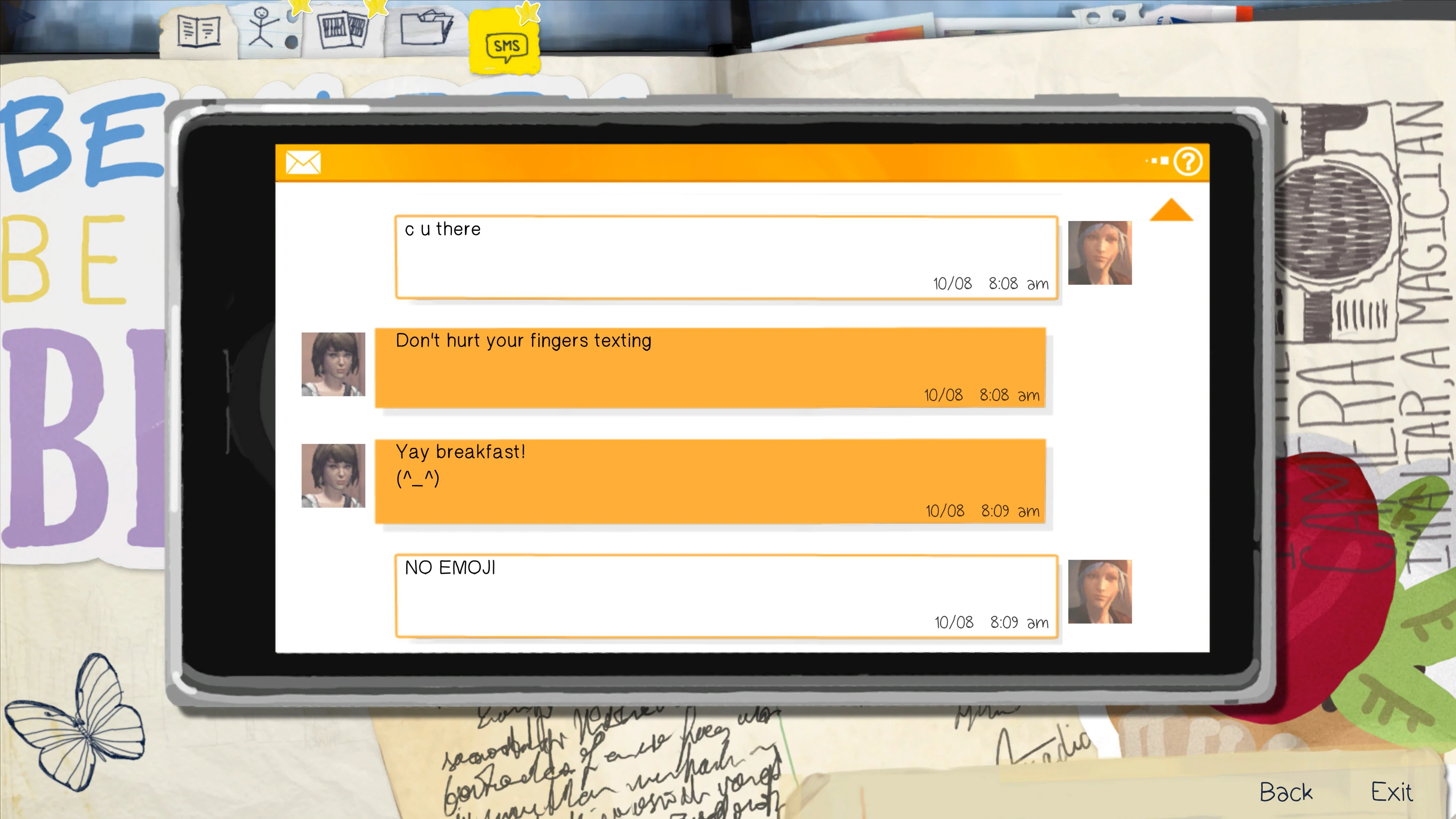
The phone messages feel different from the spoken dialogue. Characters drop punctuation, stretch words, use capitals for emphasis, and compress whole phrases into a few letters. The short forms do more than save space: they also make a message sound excited, abrupt, affectionate, or annoyed.
| Short form | Meaning | How it feels in a message |
|---|---|---|
| BTW | by the way | Adds a side note or changes the subject: “BTW, I found your charger.” |
| FYI | for your information | Introduces useful information, but can sound pointed: “FYI, the café closes at eight.” |
| OMG | oh my God | Shows surprise or excitement: “OMG, that was close.” |
| WTF | what the fuck | Shows strong shock or confusion; it is very informal and profane. |
| TTYL | talk to you later | Ends a conversation quickly and casually. |
| XO / XOXO | kisses and hugs | An affectionate sign-off rather than an acronym. |
The messages also use u, r, ur, k, thx/thanx, and txt. These are compressed spellings rather than acronyms. Reading them aloud usually reveals the full word: u sounds like you, r like are, and k stands for okay. Together, these small choices give each conversation a voice even without audio.
Learn without interrupting the game
The fastest way to ruin this kind of practice is to stop for every unfamiliar word. My rule is simple: if the line still makes sense, I keep playing. I check a phrase only when it blocks the meaning, affects a choice, or feels useful enough to meet again.
- Listen first. Let the line finish and make a quick guess from the voice and context.
- Check the whole phrase. A phrasal verb such as get away with rarely makes sense word by word.
- Return immediately. Read the explanation you need, then close it before the scene loses its momentum.
- Use one or two expressions later. Make your own short examples instead of trying to review everything.
Termy handles the middle two steps. Press Alt + X on Windows or Command + Shift + X on macOS to capture the visible subtitle and explain difficult words and phrases in context. You can change the shortcut in Termy Settings. When the overlay closes, useful vocabulary remains connected to its original sentence and screenshot for later review.
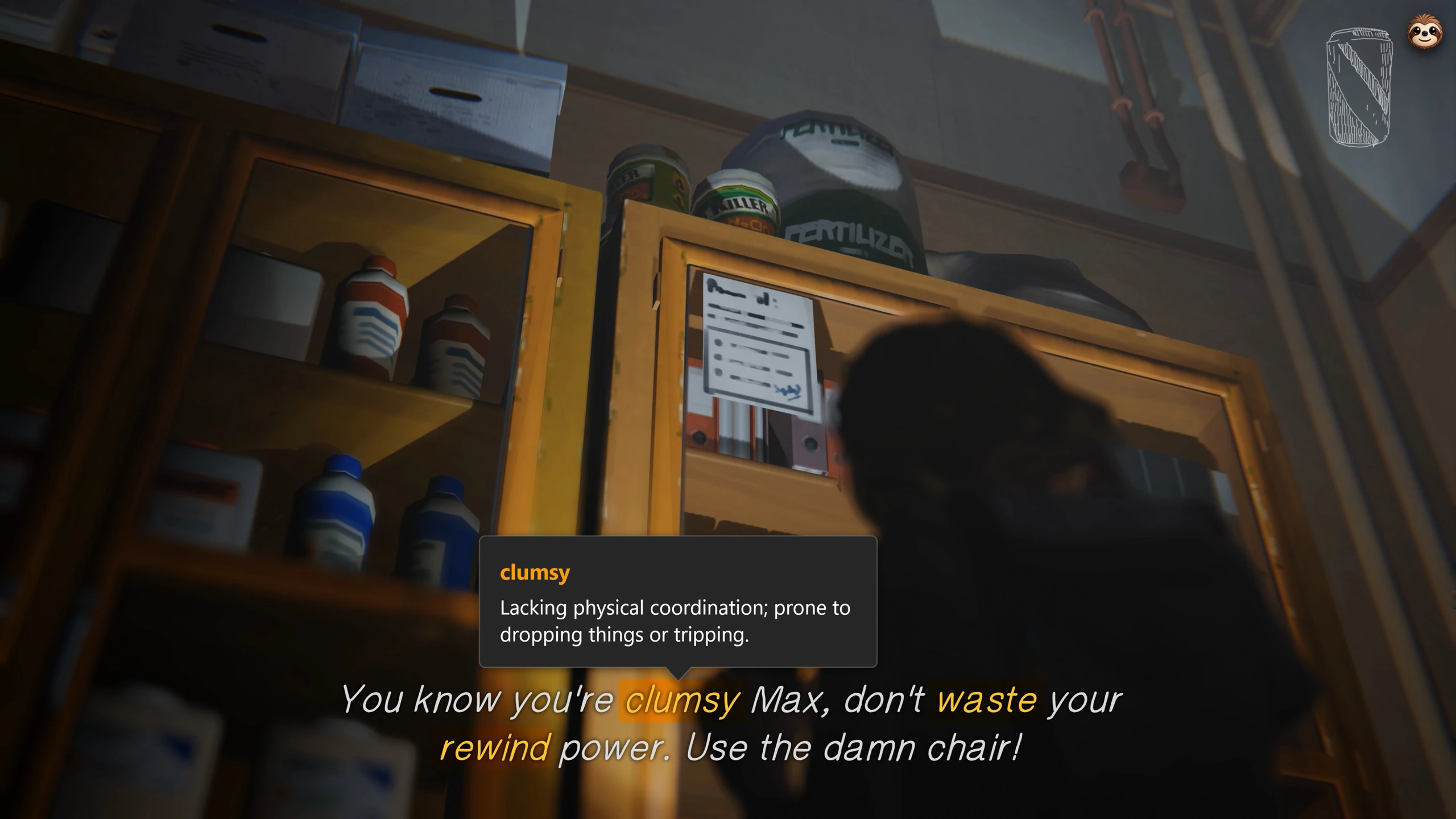
The point is not to collect the largest possible vocabulary list. It is to solve the small language problem in front of you and get back to playing. If you want to try that loop, use Termy with Life is Strange. For the broader method, read You Play Games in English—Here's How to Actually Learn From It.
Imperfect is enough
Life is Strange was never flawless. But that didn’t stop the game from finding an audience, because atmosphere, voice, and feeling mattered more than polish.
Your English does not need to be flawless either. You do not need to understand every subtitle or save every unfamiliar word. Keep the expressions that matter, let the rest pass, and continue playing. The useful language will return—and next time, it will already have a voice attached to it.
Keep the English line in front of you, get the missing meaning, and return to Arcadia Bay.
Try Termy free with Life is StrangeBack to all articles