

In Kingdom Come: Deliverance II, misunderstanding a sentence can cost more than a missed joke. A vague promise may commit Henry to a favor, an accusation can start a fight, and one unfamiliar objective can send him across half of Bohemia. That makes the game valuable language practice: words immediately change what you decide and what happens next.
The game is also enormous, dense, and fond of medieval titles. It works best when the quest stays in charge. Choose a language setup you can follow, check only the words that block a decision, and let repeated conversations, errands, trades, and arguments do most of the teaching.
Choose the right language setup before Henry starts talking
The Steam edition lists 15 interface and subtitle languages. Six of them also have complete voice acting, which gives learners three useful ways to play.
| Practice goal | Recommended setup | Best fit |
|---|---|---|
| Listen and read together | Target-language voices and target-language text | English, Czech, French, German, European Spanish, or Japanese |
| Train listening with a safety net | Target-language voices and familiar-language text | Beginners who want to hear the language without risking the plot |
| Build reading fluency | Familiar voices and target-language text | Italian, Korean, Polish, Brazilian Portuguese, Simplified Chinese, Traditional Chinese, Turkish, Russian, or Ukrainian |
Start with target voices and target text if you can understand the purpose of most dialogue choices without outside help. If every conversation feels like a test, keep the target voices but use familiar text until names, common verbs, and the rhythm of exchanges become recognizable. Reading-first learners can keep familiar voices and change the text; the interface, objectives, item descriptions, codex, and subtitles then become the practice material.

The Czech is modern on purpose
Playing in Czech does not teach the language spoken in Bohemia in 1403. That is a benefit, not a flaw. A 2025 study based partly on an interview with Warhorse quest designer Martina Daněk reports that the games use common modern Czech because Old Czech would be difficult for present-day players. The writing team also kept lists of modern English expressions that would feel wrong for the period. The result is modern, learnable language shaped to sound at home in a medieval world. The study explains the historical-language compromise in detail.
The same distinction helps in every localization. Learn ordinary verbs, social language, and complete phrases that still work today. Recognize specialist terms well enough to follow the game, but do not give a piece of armor the same attention as a phrase for refusing, apologizing, or making a deal.
Spend attention where the game gives you context
Dialogue choices reveal what a sentence is trying to do
A response may persuade, threaten, flatter, accuse, confess, or evade. The situation, the other character's expression, and the available choices narrow the meaning before every word is clear. Read the whole option first and decide its intention. Check one word only when it could reverse that intention or hide a consequence.
Social rank matters too. A noble, priest, guard, merchant, and drunk do not speak to Henry in the same register. Notice greetings, forms of address, polite requests, and insults as patterns attached to a relationship. That is more useful than copying a single dramatic line without knowing who could safely say it to whom.
Objectives turn verbs into actions
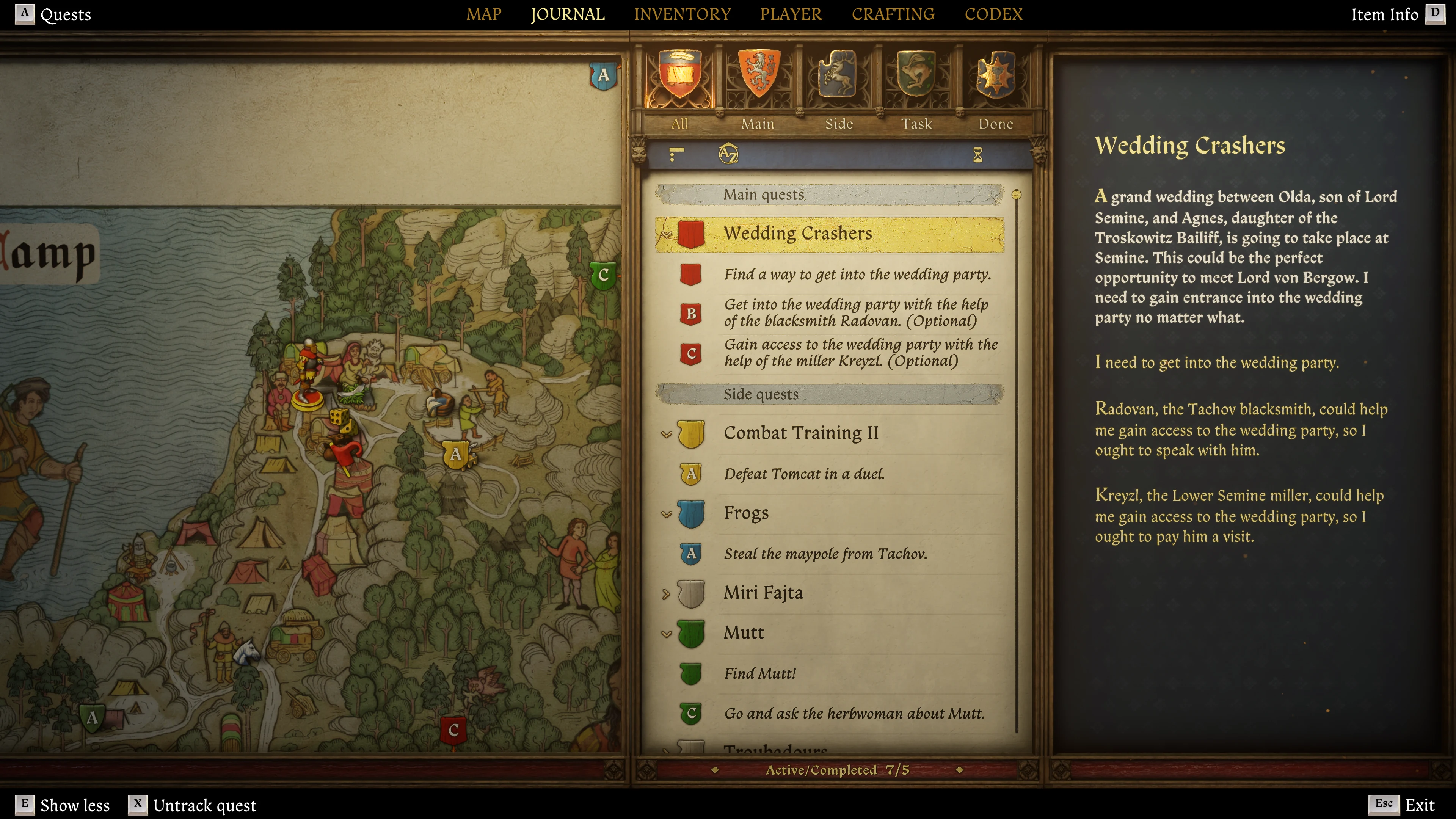
Quest instructions connect language to an immediate result: follow a person, search a room, deliver a letter, inspect an object, report to someone, or wait until morning. Try the action before checking every unfamiliar word. If the marker moves or the scene responds, the game has already supplied the definition.
Crafting and trade make repetition unavoidable
Blacksmithing, alchemy, equipment care, and shopping repeatedly pair nouns with visible objects and verbs with physical steps. Bellows, tongs, herbs, potions, repairs, prices, weight, and durability return because Henry needs them, not because a lesson scheduled them. Keep the vocabulary tied to the action: heat and hammer metal, grind and pour ingredients, repair and equip gear.
The journal, codex, and loading screens remove the timer
Quest notes, letters, books, codex entries, and loading tips let you reread a sentence without holding up a conversation. Use them when a person, place, rule, or historical detail interests you. Skip entries that feel like assigned reading. The game remains effective practice even if Henry never reads every page he finds.
Separate living language from words that belong in 1403
For English learners, medieval English vocabulary gives the story precision, but frequency inside one historical RPG does not make a word useful outside it. Sort new language by what it will help you do again.
| Keep actively | Recognize for the campaign | Usually let pass |
|---|---|---|
| Requests, refusals, apologies, promises, warnings, and reasons | Ranks such as bailiff, chamberlain, burgher, and liege | The exact name of a weapon or armor part you will not discuss elsewhere |
| Modern verbs such as accuse, owe, repair, persuade, deliver, and surrender | Trade, law, church, and military terms needed to understand a quest | Latin fragments or historical titles whose meaning the scene already makes clear |
| Whole phrases that solve recurring social situations | Craft vocabulary connected to blacksmithing and alchemy | One-off names for herbs, heraldry, coins, or equipment variants |
A useful phrase earns attention when it appears again, changes a decision, or describes something you might say. A rare noun only needs enough meaning to keep the quest moving. If medieval history is your main interest, reverse that priority deliberately; specialist vocabulary is worthwhile when it serves a real interest.
Make the subtitles easy enough to disappear
Set subtitles before an important conversation. Kingdom Come: Deliverance II includes subtitle size and high-contrast options; use a larger size and stronger contrast if your eyes keep leaving the character to decode the text. Speaker names help when several people interrupt one another, while nearby chatter is worth showing only if it remains readable during exploration.
Readable does not mean dominant. Pick the smallest size you can read comfortably from your normal distance, then test it against bright sky, a dark interior, and a crowded tavern. The correct setting lets you glance at a line and return to the face or action without effort.
Use one quest-first routine
Enter with a purpose: choose a quest, journey, or evening in town that you actually want to play. Do not add a vocabulary target. The mission supplies the context and the reason to understand.
Listen before reading: give the voice a moment, then use the subtitle to confirm what you caught. During a familiar exchange such as buying, greeting, or accepting work, try to predict the response before reading it.
Check the decision-changing word: let decorative adjectives and rare equipment terms pass. If one visible word hides who did what, what Henry is promising, or where he must go, Termy can explain it in the current sentence. Read the short explanation, make the decision, and continue.

Trust recurrence: merchants repeat transaction language, guards repeat rules, and quest givers repeat the verbs of obligation and reward. A useful word that matters will return. Save or review it only after it has earned that attention by appearing again.
Protect the scene: do not pause a duel, chase, ambush, or emotional exchange for language study. Follow the action and accept partial understanding. Quiet travel, the inventory, the journal, and the next conversation will provide safer chances to close a gap.
Adjust the challenge before changing the game
If target voices and text make every choice opaque, keep the voices and switch the text to a familiar language for the main story. Return to target text during shopping, crafting, travel, and side quests, where mistakes are cheaper. Once recurring words feel automatic, try a complete quest with both channels in the target language.
If the language feels easy, hide familiar-language support rather than collecting more words. Read long dialogue options only once, rely on voices during routine exchanges, and keep the target text available for names and consequences. The goal is faster understanding inside the game, not a larger pile of notes outside it.
Let Bohemia remain the reason to come back
Kingdom Come: Deliverance II offers enough conversation, written detail, and repeated daily activity to support a long campaign in another language. Its six voice tracks make listening practical; its text localizations give nine more languages a reading route. The method stays small: follow the quest, notice intention, check the blocker, and ride on.
For another historical open world with a very different language problem, read How to Learn a Language with Red Dead Redemption 2. RDR2 keeps English voices in every localization, so translated editions work mainly as reading practice.
Keep Henry's journey moving while Termy explains the difficult language already on your screen.
Try Termy free with Kingdom Come: Deliverance IIBack to all articles